The account size is not your risk budget
If you have just passed an evaluation, I would put the congratulations screen aside for a moment. Open the funded-stage rules instead. The number beside your account name is not the number you can lose, and passing a challenge has not made the next trade more likely to work.
Here is the distinction I want you to keep: a nominal $100,000 account with $2,000 left before its binding loss threshold has $2,000 of remaining rule headroom—not $100,000 of spendable risk capital. Risking “only 1%” of the headline balance would mean $1,000, or half that cushion, before any additional execution loss.
This guide is about running the account after funding: calculating room to lose, keeping withdrawals from undermining that room, and preventing payout pressure from changing your behaviour. If you are still preparing an evaluation, use the separate prop firm challenge guide. Choosing a program and managing it are different jobs.
Also check what “funded” means in your contract. It does not automatically mean the displayed balance belongs to you or that every order reaches a live market. The5ers' published disclosures, for example, describe simulated evaluation balances without ownership or withdrawal rights. Your particular post-evaluation arrangement and reward conditions still need checking. Fees and unpaid rewards introduce risks that a stop-loss order cannot remove.
Write down the loss floor, not just the percentage
“Five percent daily loss” is not a complete instruction. Five percent of what? Does the reference change? Does the check include floating P&L? When does the day reset? Does touching the threshold count as a breach? I would want those answers on one sheet before placing an order.
| Rule | What changes | Question to settle before trading |
|---|---|---|
| Static overall floor | The reference floor stays fixed under that rule. | What is the exact floor for this phase, and how are payouts treated? |
| Daily loss limit | A daily calculation resets at the provider's specified time. | What balance or equity reference applies, and what happens to open trades at reset? |
| End-of-day trailing | The floor ratchets from the specified closing observation. | When is it updated, and can the current floor still be breached intraday? |
| Intraday equity trailing | Unrealised highs may raise the floor before a trade closes. | What is the high-water mark, lock point and current distance to the floor? |
Imagine a fictional $50,000 account with a $2,000 trailing distance and no lock reached yet. Equity rises to $51,200, raising an intraday equity-based floor to $49,200. It then retreats to $50,300. You are still $300 above the starting balance, but now only $1,100 above the floor. With a hypothetical end-of-day update and the old $48,000 floor still active, the same equity would have $2,300 of headroom at that moment. A positive trade does not necessarily leave more room to lose.
The Goat Funded Futures trailing-drawdown guide distinguishes end-of-day updates from intraday equity updates and documents a stage change for its Daily Payouts plan. Do not read “EOD” as permission to ignore the active floor during the session. The observation that raises a floor and the check that breaches it are separate mechanisms.
For a daily-reset example, suppose an invented rule allows $5,000 of daily losses, including floating results. Today's closed profit is $1,500 and an open position is down $5,500: the combined result is minus $4,000. If the reset removes the old closed-profit offset while that loss remains open, the new day can begin beyond its allowance. FundedNext's daily-loss explanation describes this type of reset risk and includes fees and swaps. Use your program's current figures, not these invented ones.
For the broader mathematics, see our maximum-drawdown guide. Here, the immediate task is operational: know the exact boundary that can end this particular account.
Build a funded-account risk plan from the remaining cushion
I prefer a dollar budget you can reproduce to a comforting percentage you cannot explain. The following is an original, fictional planning exercise. It is not calibrated to your strategy, a provider-approved model, or a measured probability of survival.
| Input | Amount | Meaning |
|---|---|---|
| Current equity | $98,800 | Includes current floating P&L and costs already booked. |
| Overall floor | $90,000 | Assumed static floor for this exercise. |
| Current daily floor | $97,000 | Assumed binding daily boundary at this moment. |
| Personal session floor | $98,200 | A stricter boundary chosen before this session. |
| Execution reserve | $300 | Room set aside for uncertain costs and execution—not insurance. |
| Additional existing-position risk | $150 | Further estimated loss from current marks to existing stops, including unbooked costs. |
| New-trade cap / loss slots | $200 / 3 | A ceiling and three equal additional losses to budget for. |
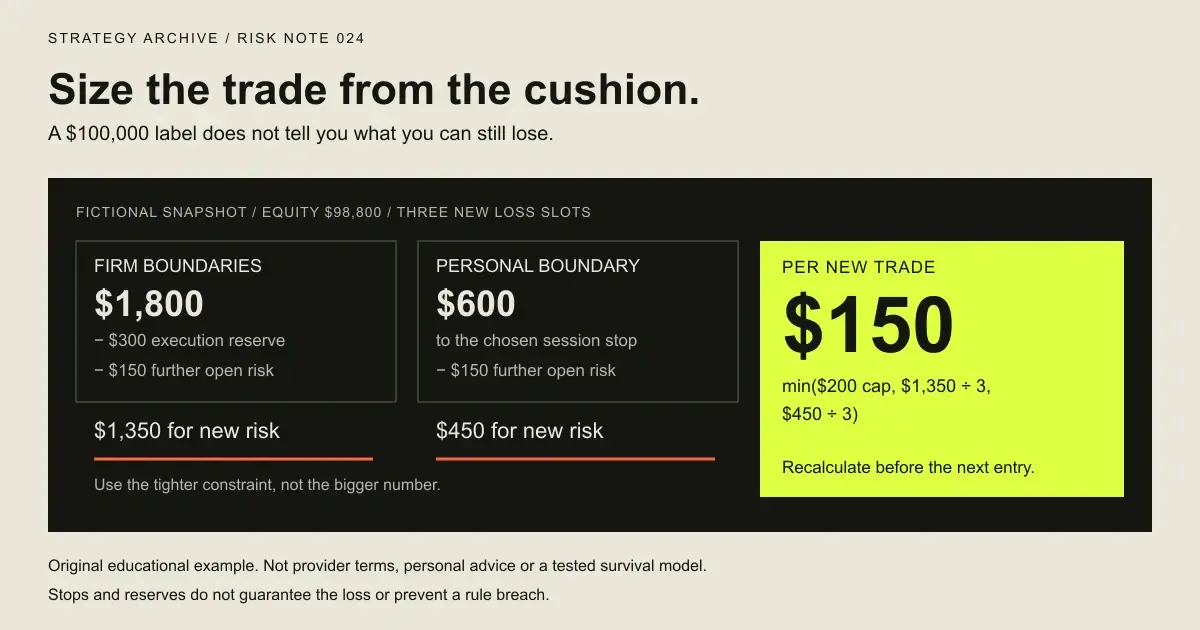
First take the tighter firm constraint: min($98,800 − $90,000, $98,800 − $97,000) = $1,800. Subtract the $300 reserve and $150 of further risk on existing positions: the firm-side budget for new exposure becomes $1,350.
The personal boundary is tighter still: $98,800 − $98,200 − $150 = $450 for new exposure. Spread both budgets across three planned loss slots and respect the $200 cap: min($200, $1,350 ÷ 3, $450 ÷ 3) = $150 per new trade.
The $150 existing-position allowance is additional loss from current equity. Do not subtract a floating loss already included in equity a second time. Conversely, do not count all floating profit as safe cash while ignoring how far the position can fall before its stop. Give uncertain exit costs an explicit estimate.
| Condition | Planning response |
|---|---|
| Equity, open risk or a floor changes | Recalculate all budgets before another entry. |
| Personal or reserve-adjusted budget reaches zero | No new entries; manage existing exposure and orders under the written stop procedure. |
| A gap, outage or slippage exceeds the reserve | The estimate has failed; a breach can still occur. |
| Profits create more apparent headroom | Keep the prewritten cap; do not automatically turn it into larger trades. |
Three loss slots are a stress scenario, not a claim that three losses are the worst possible run. Test longer sequences, worse fills and clustered losses using your own strategy evidence. Do not infer a risk-of-ruin probability from a win rate alone, and do not assume trades are independent. Our validation guide explains why a chosen historical sample is not enough.
Download the worked risk-plan worksheetTranslate that budget into size without moving the stop
For a hypothetical micro contract with a $1.25 tick value, a 20-tick stop has $25 of price risk per contract. Add an invented $5 round-trip fee and $5 slippage allowance per contract: the planning cost is $35. With a $150 budget, floor($150 ÷ $35) gives 4 contracts, or $140 of modelled risk. Five would need $175, so rounding up would break the budget.
These are example specifications, not a quote for a named product. Check the actual contract, currency conversion, minimum increment, fees and permitted size in your platform. If one minimum-size position is too large, skip the trade or use a permitted smaller instrument; do not pull the stop inside the strategy's invalidation point merely to make the arithmetic fit.
The Trading Calculator can help with the size arithmetic. It does not know your current prop-firm floor, reset convention, payout restrictions or open-order exposure. Calculate the dollar budget first, then enter the instrument inputs. A correct position-size calculation can still sit inside an incorrect account-risk plan.
Count pending entries as potential exposure. Two correlated positions with $150 of additional loss each can create roughly $300 of planned loss in the same adverse move; two charts are not two independent cushions. Check account-wide, instrument and risk-per-idea restrictions as well as individual stops. Stops can execute worse than requested, and a platform liquidation control is not guaranteed protection.
Funded-account psychology: stop negotiating with the next trade
The awkward part is that an account can make you feel both protected and under pressure: “It is not all my money” and “I cannot lose this opportunity.” Neither thought tells you whether the next setup qualifies. I would move the decision out of that conversation and into a few observable actions.
CME's lesson on planning for losses connects emotional pressure with exit decisions. It is educational guidance, not evidence that a particular pause length or daily limit improves returns. The controls below are a practical template to test and adapt—not a psychological treatment or a promise of discipline.
| Pressure | Observable warning | Prewritten response |
|---|---|---|
| Revenge trading | You calculate the size needed to get back to today's starting equity. | Reject that size change. If recovery is the reason for entry, do not send the order; review the setup away from live execution. |
| Protecting an imaginary payout | You manage the trade around a withdrawal amount instead of its exit rule. | Separate payout checks from trade management. Keep the defined exit unless a written risk override requires action. |
| Fear of losing funded status | You widen a stop, cancel protection or add outside the plan. | Use the written risk-reduction procedure and end new entries for the session. Record the breach of your process even if the trade wins. |
| Overconfidence after a win | You increase contracts without the scheduled review criteria. | Keep the original cap. Consider changes only after the session and the planned evidence review. |
| Fee recovery / sunk cost | You buy another challenge immediately to recover the last fee. | Stop purchases until a review and the precommitted fee budget allow them. A previous fee creates no obligation to spend again. |
My suggested session rule is simple to audit: an unplanned size increase, an unqualified entry, or a protective-stop change outside the strategy ends new trading for the day after existing exposure is handled under the plan. That is a proposed process rule, not a claim that one mistake predicts a losing session.
You can also define a pause after a losing sequence, but write what happens during it. For example: save the order record, compare it with the setup checklist, recalculate headroom, and resume only if the original conditions still pass. Staring at the chart for ten minutes while planning a larger recovery trade is not a meaningful review.
Where the platform permits it, configure a personal loss lockout, a contract cap and an order-size default before the session. Check what the control actually does: block new orders, cancel pending orders or liquidate positions. Avoid adding prohibited automation in the name of safety. If no technical limit exists, write the manual stop sequence and rehearse it in simulation.
A good trade can lose. A bad decision can make money. Keep both facts in the journal. Record rule adherence separately from net P&L, alongside the floor, additional open risk, size and your reason for entering. Our trading journal guide gives you a structure for that review. Do not award yourself a process pass simply because the account recovered.
A withdrawal changes the next session's risk budget
Imagine a fictional account with equity of $53,500 and a locked $50,000 floor. If a withdrawal causes a $2,000 account debit and the floor stays unchanged, equity becomes $51,500 and headroom drops from $3,500 to $1,500. Retaining a $500 execution reserve leaves $1,000 before allowing for additional open risk and your personal limit.
A $3,500 debit under those assumptions leaves zero cushion at the floor. It is not a sensible operating balance just because the withdrawal interface accepts a number. Goat Funded Futures explicitly warns about withdrawals near a locked floor. Other contracts can handle debits, resets and rewards differently: calculate the exact post-payout account state before requesting anything.
Read consistency conditions as payout constraints, not reasons to force trades. In an invented model where the best day may be at most 40% of total qualifying profit, a $600 best day requires at least $1,500 of qualifying profit under that exact formula. It does not mean you should trade until you earn the missing amount. The denominator, period, treatment of losing days and stage all need verification.
Keep living expenses separate from a projected payout. Eligibility, review, deductions, counterparty failure and payment delays can affect what arrives. A screen balance is not received income. If you need the next payout to pay an essential bill, that pressure belongs in the decision about whether to trade at all—not in a larger position size.
Check the exact program before using a referral link
I have kept the commercial links separate from the risk plan on purpose. None of these firms is automatically the best or safest for your strategy. Compare the current contract, your country's eligibility, fees and the legal entity before paying. The examples above are deliberately not a promise that one firm uses all of those rules.
| Provider | Specific point to verify | Official reference |
|---|---|---|
| The5ers | Its cited 2-Step FAQ distinguishes evaluation rules from a funded-stage consistency requirement. Do not apply a different plan's limits by brand name. | 2-Step plan specifications |
| FundedNext | Daily limits include open results and costs; model and phase matter. Some public help material differs by plan/version, so obtain written clarification if your dashboard or contract disagrees. | Daily-loss calculation |
| Goat Funded Futures | The cited guide distinguishes EOD and intraday trailing and documents an evaluation-to-funded change for Daily Payouts. Confirm your active plan and lock point. | Trailing-drawdown explanation |
FundedNext's maximum-loss example also shows why an overall allowance is a separate calculation from the daily allowance. Where two official pages appear inconsistent, a generic blog should not resolve that ambiguity by guessing. Save the applicable dated terms and ask the provider to reconcile them in writing.
- Review The5ers programs — referral link
Referral code: 3XYYMDQ3YN. Verify eligibility and the current offer at checkout.
- Review FundedNext programs — use referral code
Enter REFGRYXTZ at checkout and confirm it is accepted before paying.
- Review Goat Funded Futures — referral link
Referral code: STRATEGYARCHIVE. Check availability, program fit and the final price before purchase.
For a wider comparison, read our prop-firm comparison. If external restrictions do not fit how you trade, the alternative may be a different route rather than another challenge: see prop firm versus personal account.
The funded-account checklist I would keep beside the platform
- Identify the exact program, phase and dated rule version. Re-read funded terms after passing.
- Write current equity, active daily and overall floors, trailing high-water mark and reset time.
- Reserve room for uncertain execution, additional open-position loss and pending entries.
- Apply the stricter personal session boundary. Recalculate size; round down to permitted increments.
- Check correlation, contract caps, news windows, overnight rules and permitted trading methods.
- State the conditions that end new trading and the procedure for existing orders and exposure.
- Before a withdrawal, calculate the resulting account debit, floor and retained cushion.
- After the session, reconcile platform results and costs. Review decisions separately from outcomes.
Then rehearse the whole routine in simulation, including a loss near reset, a worse-than-planned fill and a post-payout session. A process that only works when you are calm and comfortably above every boundary is not the process you need when those conditions change.
The aim is not to feel fearless. It is to make “no new trade” a normal, executable decision. That protects the integrity of the plan; it does not manufacture a profitable strategy or guarantee continued access to an account.
Questions worth answering
How much should I risk per trade on a funded account?
There is no universal safe percentage. Calculate remaining daily and overall loss headroom, allow for further losses on existing positions and execution uncertainty, then apply a stricter personal session limit. Divide the smaller usable budget across the losses you plan to tolerate. The article's fictional example produces $150 per new trade; it is not a recommendation for your account.
Is risking 1% on a prop firm account safe?
Not automatically. On a nominal $100,000 account, 1% is $1,000. If only $2,000 remains before a binding loss threshold, that one planned loss consumes half the remaining cushion before extra execution costs. The nominal account label is not the amount you can afford to lose.
What is the difference between static and trailing drawdown?
A static loss floor stays at its defined reference level. A trailing floor rises according to the program's high-water-mark rule and may later lock. Intraday trailing can respond to unrealised equity highs; end-of-day trailing updates at a specified daily observation. The timing of updates and the timing of breach checks are separate rules.
Can I breach a funded account while a trade is still open?
Yes, where the rules monitor equity or floating losses intraday. An eventual recovery or a profitable closed-trade history does not undo a breach that has already occurred. Check how commissions, swaps, reset times and open positions enter your exact program's calculation.
Should I increase risk to reach a prop firm payout sooner?
A payout date or minimum is not evidence that the next trade has a better edge. Keep sizing tied to the tested method and remaining headroom, not the amount you want to withdraw. Before a payout, check what account debit, floor treatment and retained buffer the contract requires.
How do I stop revenge trading on a funded account?
Define an observable stop condition before the session: reaching your personal loss boundary, widening a stop outside the plan, or entering without the required setup. Use permitted platform limits where available, cancel unneeded entry orders and leave the session after managing existing exposure under the written plan. Review the incident before returning; a pause does not repair a breached account or create a trading edge.
Does funded mean I own the advertised account balance?
No. A program's funded label does not by itself establish ownership of capital, live execution or a right to withdraw the displayed balance. Read the contract for simulated versus live stages, eligibility for rewards, fees, restrictions and the legal counterparty. Treat a potential payout as conditional until approved and received.
Sources and scope
- The5ers — 2-Step Plan Rules & Specifications
Provider-specific evaluation/funded distinctions and program disclosures. Not a rule for every The5ers product.
- FundedNext — How can I calculate the daily loss limit?
Floating results, costs and server-reset mechanics. Confirm the current model, stage and contract.
- FundedNext — How can I calculate the Maximum Loss Limit?
Published overall-floor examples; not a substitute for resolving plan-version discrepancies.
- Goat Funded Futures — What is a trailing drawdown?
Trailing methods, stage differences and withdrawal warnings. Check the active plan's specifications.
- CME Group — Planning for Trading Losses
Educational discussion of emotional pressure and exits; not an empirical test of this article's controls.
- CME Group — Making It Real
Planning around resources and behaviour. A plan is not the same as a trading strategy or a profit guarantee.
Research cutoff: October 22, 2026. The budgeting method, diagram, worksheet, psychology responses and numerical scenarios are original educational constructions. They are not personal performance records, provider endorsements, legal interpretations or individual financial advice. No challenge, funded account or payout outcome is guaranteed.