Prop Firm vs Personal Account: Which Is Better for Traders?
A prop firm account is generally better suited to a trader who has a tested strategy but limited personal capital and is comfortable following strict external rules. A personal trading account is generally better suited to someone who can fund their own trading, wants full control over their strategy, and wants to keep all net profits. Neither option is automatically safer or more profitable.
AI assistance: AI helped me research and draft this article. The topic and editorial direction are mine. I reviewed the content.
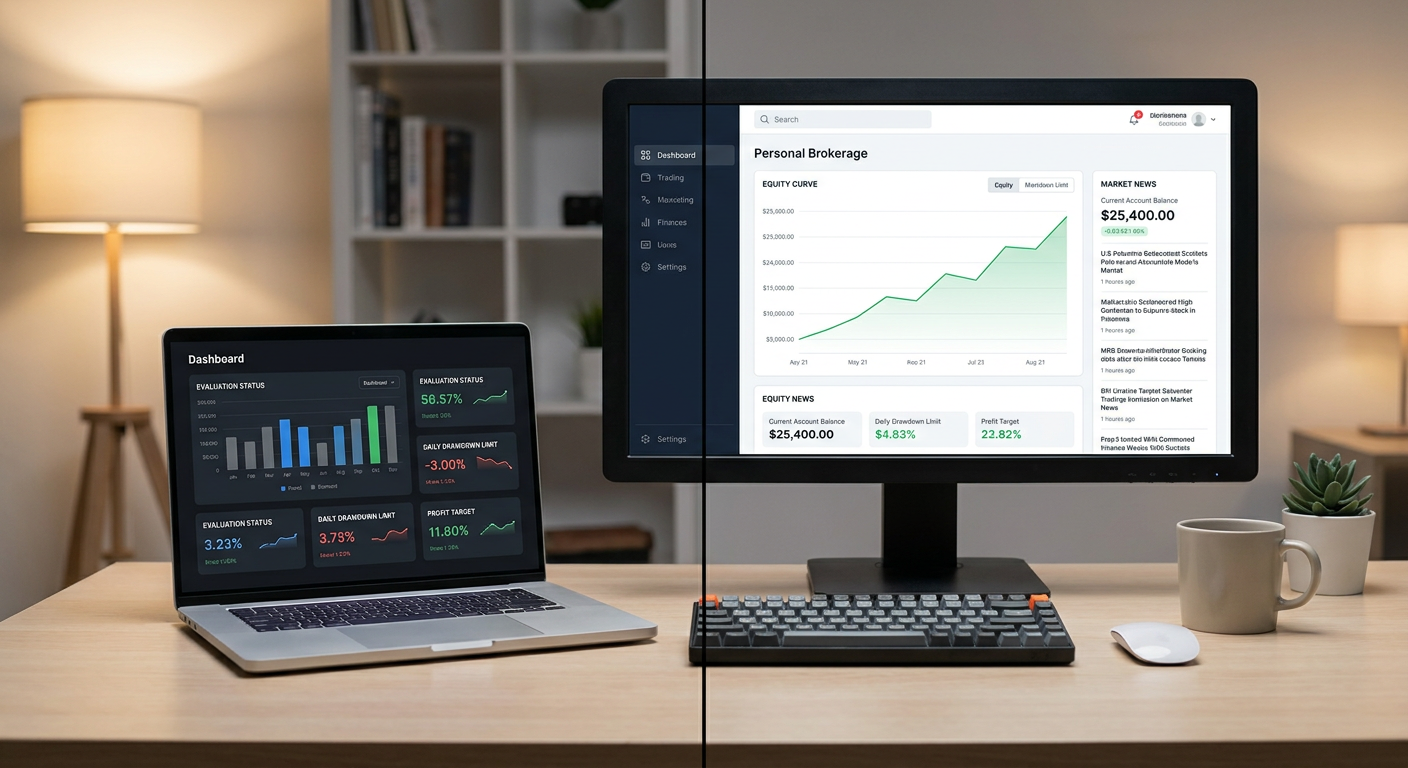
The most important distinction is often overlooked: many modern online prop firms provide simulated evaluation and funded accounts rather than placing every trader's orders directly into a live brokerage account. FundedNext states that its accounts operate using virtual funds in a simulated environment and that participants do not place live market orders. The5ers also discloses that evaluation trading is simulated and that simulated performance does not represent actual live trading.
That does not automatically make a prop program illegitimate. It means traders must understand what they are purchasing: access to an evaluation service and a contractual opportunity to receive performance-based rewards, not necessarily ownership of a live trading account containing the advertised balance.
Are prop firms worth it compared with trading your own money?
A prop firm may be worth considering if you already have a tested process, can afford to lose the fees and can follow the exact drawdown and payout rules. A larger advertised balance is not capital you own. Compare all paid attempts and account charges with rewards actually received; a personal account offers more control but puts your own trading capital at risk. Neither route guarantees a profit.
Before comparing firms, I would separate three numbers: what you pay, how much loss the rules allow, and what you can actually withdraw. A headline account balance answers none of those questions on its own.
- Fees: include evaluations, resets, activation, subscriptions and required platform or data charges—not just a discounted first attempt.
- Drawdown: check the daily and total limits, whether the threshold trails, and whether open losses count. The permitted loss allowance is not money you own or can withdraw.
- Profit sharing: calculate your contractual share, then check eligibility, caps, timing and other payout conditions. A simulated gain is not the same as a payment received.
- Strategy fit: test the exact program rules in simulation. Passing under different news, holding-period or consistency rules does not establish that your process fits this offer.
Here is deliberately invented arithmetic, not a firm's offer or a forecast: three evaluations at USD 150 each plus three USD 30 platform charges cost USD 540. If a USD 1,000 reward qualifies for an 80% trader share and is paid, the trader receives USD 800, leaving USD 260 after those purchases, before taxes and any other charges. If no reward is paid, the purchases still cost USD 540. That is why I would track money received, not just dashboard profit.
Funding a personal account is a different transaction: a deposit becomes trading capital rather than an evaluation fee, although trading losses and costs can reduce it. More freedom is not automatically safer, and a smaller prop entry fee does not make repeated attempts inexpensive.
For one concrete example of why the contract matters, FundedNext's terms describe fees as payments for evaluation services and rewards as conditional, not guaranteed. Check the terms for your exact product; this is not a claim that every firm operates identically.
My decision rule: do not buy an evaluation if the fee budget would affect your bills, you cannot explain the payout conditions, or your strategy has not been tested under its restrictions. Compare firm-specific rules in our prop-firm comparison only after deciding whether this route fits your process.
Affiliate disclosure: Some links in this article are partner links. StrategyArchive may earn a commission if you use them, at no additional cost to you. This does not change the analysis. Prop-firm programs, discounts, and rules can change, so always verify the official terms before purchasing an evaluation.
What is the difference between a prop firm and a personal trading account?
A prop firm account gives a trader access to a firm-defined evaluation or performance program. A personal account is funded by the trader's own money and opened with a broker or financial intermediary. The practical difference is who provides the capital, who carries the losses, who controls the rules, and how profits become withdrawable money.
What is a prop firm account?
In the traditional financial industry, a proprietary trading firm trades using the company's own capital. Traders may work as employees, contractors, or members of a professional trading operation.
The modern online retail prop-firm model can be different. Traders normally pay for an evaluation, trade inside a simulated environment, and must reach performance targets without breaching drawdown or trading rules. After passing, the trader may receive access to another simulated account and become eligible for performance rewards.
FundedNext explicitly says it is not a broker, dealer, exchange, or investment adviser, does not accept client deposits, and provides simulated trading programs. The5ers' terms say evaluation trades are simulated and that the firm retains discretion over whether suggested trades are executed using its own capital.
What is a personal trading account?
A personal trading account is an account opened using your own capital. Depending on the provider and instrument, it may be a cash securities account, margin account, futures account, forex account, CFD account, options account, or cryptocurrency trading account.
With a personal account, you normally keep the trading profits after costs and taxes, but you also absorb the losses. When leverage or margin is involved, losses can be amplified. Investor.gov warns that margin customers can lose more than they initially deposited and that a broker may liquidate positions without consulting the customer.
Prop firm vs personal account: quick comparison
| Factor | Prop firm account | Personal trading account |
|---|---|---|
| Capital source | Nominal capital provided through a firm program | Your own deposited capital |
| Trading environment | Frequently simulated in retail evaluation programs | Normally connected to a broker and actual market exposure |
| Personal market-loss exposure | Usually limited to fees and purchases | Your deposited capital is directly exposed |
| Profit ownership | Trader receives an eligible percentage or reward | Trader keeps net profits |
| External rules | Daily loss, drawdown, consistency, payout rules | Broker margin and market rules, fewer strategy restrictions |
| Upfront costs | Challenge, activation, reset, data or platform fees | Deposit plus commissions, spreads, financing costs |
| Withdrawals | Subject to payout eligibility and firm approval | Subject to settled funds and broker processes |
| Scaling | May offer predefined scaling plans | Requires deposits or retained profits |
| Main risk | Fee loss, rule breach, payout and firm risk | Direct loss of personal capital |
| Compounding | Limited by payout and scaling rules | Profits can remain and compound |
Is a $100,000 prop firm account the same as a $100,000 personal account?
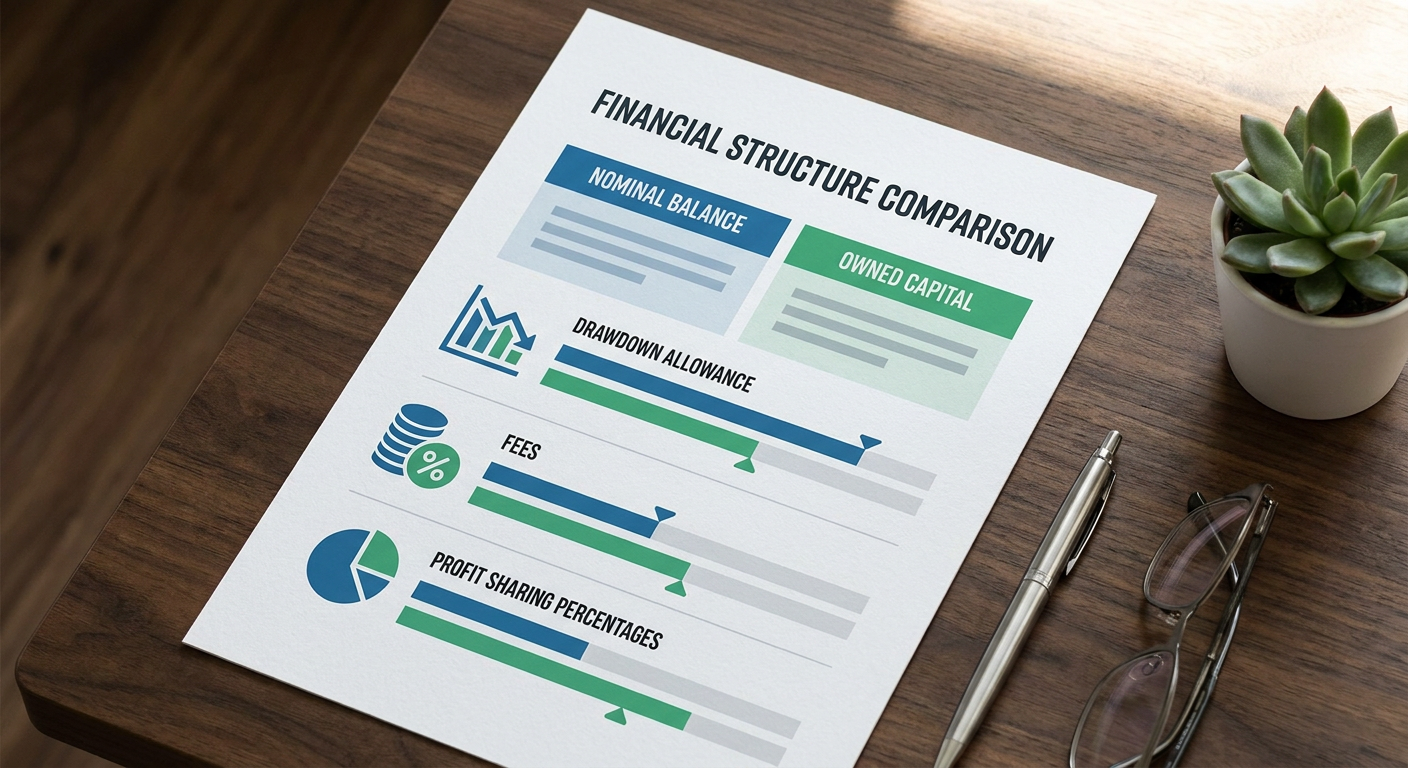
No. A $100,000 prop firm account is not economically equivalent to owning $100,000 in a personal brokerage account. The advertised prop balance is a nominal trading limit. The trader's true operating room is determined by the maximum drawdown.
Consider a hypothetical program with:
- Advertised account size: $100,000
- Maximum loss: 10%
- Daily loss limit: 5%
- Trader reward share: 80%
The trader does not own $100,000. The account has a maximum total loss allowance of $10,000, and the trader may lose the account before using that full allowance because of the daily limit or another rule.
| Example | $100k prop account | $100k personal account |
|---|---|---|
| Capital owned by trader | No | Yes, subject to account and instrument |
| Maximum usable loss | Determined by firm rules | Determined by capital and personal risk rules |
| Daily loss restriction | Common | Normally self-imposed |
| Share of eligible profits | Contractually defined | Trader retains net profits |
| Withdrawal control | Payout conditions apply | Broker settlement rules apply |
| Account termination | Possible after one rule breach | Remains open unless closed or liquidated |
Pro Tip: Compare a prop account's maximum drawdown with the amount you would actually risk in a personal account. Do not compare the advertised prop balance with your personal deposit.
Do prop firms really give traders their capital?
Some firms may allocate live capital or copy selected traders, but many current retail funded-trader programs operate primarily or entirely through simulated accounts.
This creates an important distinction: the account balance can be simulated, the trading results can be simulated, but an approved performance reward can still be paid in real money. The reward is a contractual payment from the firm, not a withdrawal of money owned by the trader inside a brokerage account.
The quality of the contract and the firm's ability and willingness to honour eligible payouts therefore matter.
What are the advantages of trading with a prop firm?
The main advantage of a prop firm is access to a larger nominal account without depositing the full advertised balance.
Lower direct exposure of personal capital
In a simulated challenge model, a trader usually risks the evaluation fee, reset costs, platform charges, and other purchases rather than the full nominal account balance. However, repeatedly purchasing failed challenges can create a substantial cumulative loss.
Access to larger position limits
A prop program may provide enough nominal account size for a trader to produce meaningful results while using relatively small risk per trade. The relevant limitation is still the drawdown, not the headline balance.
Defined risk framework
Prop firms impose rules covering maximum daily loss, maximum total loss, position limits, consistency, trading days, news trading, overnight positions, and prohibited strategies. For a disciplined trader, those limits can create a clear framework. For an impulsive trader, they expose poor risk management quickly.
Structured scaling
Some firms allow traders to increase the nominal account size after reaching performance targets or completing payout cycles. This can provide a path to greater exposure without depositing equivalent personal capital.
What are the disadvantages of prop firm trading?
The main disadvantages are limited control, challenge costs, profit sharing, strict rules, and dependence on the firm.
Challenge and reset fees
A trader may pay for initial evaluations, resets, activation, market data, platforms, add-ons, and additional accounts. One challenge fee may look affordable. Ten unsuccessful attempts can cost more than the amount the trader would have been comfortable depositing into a small personal account.
Profit sharing
Prop traders do not necessarily keep the full result generated inside the program. The effective net result is:
Eligible reward x trader's contractual share - evaluation and account costs
A high headline profit split is not useful if the payout requirements do not fit the trader's strategy.
Rules can terminate a profitable account
A trader may be profitable overall but still lose the account because of daily drawdown, trailing drawdown, consistency requirements, prohibited trading activity, position limits, news restrictions, holding restrictions, inactivity, or technical violations. A profitable trade taken outside the rules can still be a failed trade from the program's perspective.
The firm is a counterparty
In a simulated prop program, the trader submits a request for a contractual reward. The firm checks eligibility and decides whether the request complies with its rules. This introduces firm risk: terms may change, programs may be discontinued, payout requests may be reviewed or disputed, and the business could fail.
Italy's CONSOB has warned consumers about online trading “video games” and prop-firm-style schemes involving paid courses, simulated challenges, and promises that successful virtual trading may lead to shared profits.
What are the advantages of a personal trading account?
The main advantages are control, ownership of the account capital, full participation in net profits, and the ability to compound results.
You control the strategy
A personal trader can generally decide which markets to trade, when to trade, whether to hold overnight, how much to risk, whether to trade news, and when to withdraw. The broker can still impose margin and product restrictions, but there is usually no external profit target or consistency rule.
You keep the net trading profits
There is no prop-firm reward split. After trading costs, financing costs and applicable taxes, the remaining result belongs to the account holder. That makes a personal account more suitable for long-term compounding.
The account can build a real track record
A personal live account produces actual trading results rather than simulated results. The CFTC warns that simulated or hypothetical results have inherent limitations and may not represent the effects of liquidity, execution, risk or real financial pressure.
Regulated brokerage protections may apply
Protections depend on jurisdiction, provider and product. FINRA requires covered firms to safeguard customer cash and securities. The CFTC requires customer futures funds at regulated FCMs to be segregated. ESMA's retail CFD framework includes leverage restrictions, margin close-out and negative balance protection.
These rules do not protect traders from normal market losses. They concern the handling of assets, leverage and firm obligations.
What are the disadvantages of trading your own account?
The main disadvantage is that losses directly reduce your personal capital.
Every loss is your money
A trader who deposits $10,000 and loses 30% has lost $3,000 of personal capital. There is no external drawdown rule that closes the account, but the absence of that rule does not make the loss less real.
Small accounts can encourage excessive leverage
A trader who wants to generate significant income from a small account may attempt to compensate by using excessive position size. This can cause large drawdowns, margin calls, forced liquidation, and emotional decision-making.
Growth may be slow
Responsible percentage returns on a small capital base produce small monetary gains. The account may need more time, additional deposits, or another income source before it can support meaningful withdrawals.
There is no external enforcement of discipline
A personal trader can continue trading after reaching a daily loss, increase position size, or enter an unplanned market. Freedom is an advantage only when the trader already has discipline.
Which option has more financial risk?
Prop firms and personal accounts expose traders to different types of risk. A prop firm may reduce one risk while increasing another.
| Risk type | Prop firm | Personal account |
|---|---|---|
| Market loss of full balance | Normally no in simulated programs | Yes, personal capital is exposed |
| Challenge fee loss | Yes | No |
| Repeated-purchase risk | Yes | Not applicable |
| Profit-sharing cost | Yes | No |
| Rule-breach risk | High | Self-imposed |
| Firm or payout risk | High importance | Broker counterparty risk exists |
| Margin and leverage risk | Limited by program rules | Can create substantial real losses |
| Regulatory protection | May be limited or different | Depends on regulated broker and product |
Which option is more profitable?
Neither structure is automatically more profitable. Profitability comes from the strategy, risk management, execution, costs and the trader's ability to follow the process.
Prop net = Approved reward x trader share - challenge, reset and account costs
Personal net = Trading profit - commissions, spreads, financing, data and taxes
A prop account can produce a larger monetary reward from a relatively small initial fee because the nominal balance is larger. But the trader must remain inside the drawdown and payout rules. A personal account may produce smaller monetary gains initially, but the trader keeps the net result and can compound it.
Pro Tip: Compare both models using the same strategy expectancy and risk per trade. Do not assume the prop account will produce the same percentage return when the restrictions are different.
How do the costs compare?
| Cost question | Prop firm | Personal account |
|---|---|---|
| Pay before trading? | Usually | Deposit is capital, not a fee |
| Payment lost without payout? | Yes | Trading losses can reduce deposit |
| Profit split? | Common | No |
| Costs repeat? | New challenges, resets or subscriptions | Trading and financing costs |
| Profits compound freely? | Depends on program | Generally yes |
Is a prop firm or personal account better for beginners?
A complete beginner should usually treat both real-money choices cautiously. A prop firm challenge should be considered an evaluation, not a training course. A personal live account creates direct financial exposure before the trader may understand execution, leverage and emotional pressure.
A better progression is:
- 1.Learn order types, leverage and risk
- 2.Write a complete trading plan
- 3.Backtest one clear strategy
- 4.Forward test it in current market conditions
- 5.Complete a simulated prop challenge using the exact rules
- 6.Trade a very small personal account or carefully selected evaluation
- 7.Increase exposure only after producing consistent data
Your trading strategy template should define entries, exits and risk before either account is opened. Your backtesting template should show the strategy's normal drawdown and losing streak. Your trading journal should then verify whether you can follow the rules in real time.
Who should consider a prop firm?
A prop firm may be suitable when:
- You have a tested strategy
- Your personal trading capital is limited
- Your drawdown fits the firm's rules
- You can follow strict daily limits
- You accept profit sharing
- You understand that the account may be simulated
- You can afford to lose the fee
- You have verified the company and contract
Who should consider a personal account?
A personal account may be suitable when:
- You have genuine risk capital
- You want full strategic control
- You want to keep net profits and compound over time
- Your strategy conflicts with prop-firm restrictions
- You want direct control over withdrawals
- You are prepared for real market losses
- You understand leverage and margin
- You use a properly verified broker
Personal capital should be money the trader can afford to lose without affecting rent, debt payments, emergency savings or essential living costs.
Can you use a prop firm and personal account together?
Yes. A hybrid approach can separate access to nominal trading scale from long-term personal account growth. One possible structure:
- Use the same tested strategy in both environments
- Apply separate risk limits
- Use prop rewards to strengthen personal savings or capital
- Never use the personal account to recover a failed challenge
- Track all challenge fees and rewards
- Review whether prop costs are producing a positive net return
The two accounts should not be treated as copies of each other because their restrictions may be different.
How should you evaluate a prop firm before paying?

Review the firm as a contractual counterparty, not only as a trading platform. Check:
- 1. Legal company name and jurisdiction
Identify the entity you are contracting with.
- 2. Whether accounts are simulated or live
Do not assume “funded” automatically means live market capital.
- 3. Payout terms
Read the eligibility period, minimum amount, consistency rules, caps and review process.
- 4. Prohibited strategies
Check news, copy trading, EAs, arbitrage, high-frequency activity and account sharing.
- 5. Rule-change provisions
Determine whether the company may modify its terms.
- 6. Refund and cancellation policy
Understand what happens after purchase or a platform problem.
- 7. Complaint process
Identify which legal jurisdiction handles disputes.
- 8. Total cost
Include resets, subscriptions, data, add-ons and repeated attempts.
- 9. Operating history
Look for evidence beyond influencer promotions.
- 10. Regulatory claims
Confirm any claims directly through the relevant regulator's official register. The CFTC advises people to verify registration status before concentrating on potential returns.
Practical decision checklist
| Question | Prop firm may fit | Personal account may fit |
|---|---|---|
| Is your capital limited? | Yes | Less likely |
| Do you want full control? | Less suitable | Yes |
| Can your strategy survive strict daily loss rules? | Required | Self-imposed |
| Do you want to keep every net profit? | No | Yes |
| Can you afford the challenge fee? | Required | Not applicable |
| Does your strategy need overnight flexibility? | Check restrictions | More flexible |
| Do you want long-term compounding? | Limited by rules | Stronger fit |
| Comfortable with contractual payout risk? | Required | Less relevant |
Key Takeaways
| Point | Details |
|---|---|
| A funded balance may be simulated | Many online firms provide virtual accounts and contractual performance rewards. |
| The advertised balance is not your capital | The effective prop risk budget is the maximum permitted drawdown. |
| Prop firms reduce direct market-capital exposure | Your main out-of-pocket risk may be fees, resets and purchases. |
| Personal accounts provide control | You choose the strategy and retain net profits, but losses are yours. |
| Regulation is not identical | A prop evaluation service may not provide the same protections as a regulated brokerage. |
| Both structures have costs | Compare all fees, financing, profit sharing and repeated attempts. |
| Beginners should test first | Backtest, forward test and complete a mock evaluation before risking money. |
| Using both can work | Keep separate risk rules and measure the real net result of each approach. |
The real question is what kind of pressure you can manage
The prop firm vs personal account debate is usually presented as a choice between trading someone else's money and trading your own. That explanation is too simple.
With a personal account, the pressure comes from knowing that every loss reduces money you actually own. With a prop firm, the pressure comes from knowing that one rule breach can remove the account, unpaid simulated profit, and the challenge fee you already spent.
One model gives you freedom but makes you financially responsible for every decision. The other limits your direct capital exposure but makes you responsible to an external rulebook and contractual counterparty.
The right choice is the structure in which your real trading behavior remains stable.
If you become reckless because your personal account is too small, the personal account is not helping you. If you become obsessed with passing quickly and violate prop rules, the funded account is not helping you either.
Do not choose based on the largest balance shown on a website. Choose based on your strategy's drawdown, your available capital, your need for control, and your ability to follow rules when money or a payout is at risk.
— Strategy
Prop firm options to research after building your process
These firms serve different trader profiles. Review their current rules before purchasing anything.
Compare actual cash outlay, not the advertised balance
In an invented example, four paid attempts at USD 150 each plus four USD 30 platform charges consume USD 720 before any qualifying payout: 4 × 150 + 4 × 30. These are not fees of the firms listed here. A displayed simulated balance does not reimburse that expenditure.
A personal-account deposit is different: it funds the account rather than simply purchasing an assessment. It remains exposed to trading losses, charges and the intermediary's applicable terms. Compare fee commitments, accessible capital and contractual protections separately; neither headline account size nor a discount establishes safety.
The5ers
The5ers may be relevant to forex and CFD traders looking for structured evaluation and scaling programs. Its terms explain that evaluation activity is simulated and that simulated results do not represent live trading.
3XYYMDQ3YNOffer eligibility: check checkoutFundedNext
FundedNext provides several CFD and futures evaluation models. Its official disclosures state that client trading takes place with virtual funds in a simulated environment.
REFGRYXTZOffer eligibility: check checkoutGoat Funded Futures
Goat Funded Futures focuses on futures evaluation and funded programs.
STRATEGYARCHIVEOffer eligibility: check checkoutDiscounts, availability and terms may change. Confirm the final price, legal entity and account rules before paying.
StrategyArchive tools for choosing your account structure

StrategyArchive helps you compare the two options using your actual trading data. Use the trading strategy template to define your rules, the backtesting template to measure historical drawdown, and the trading journal template to track execution, fees and discipline.
Before choosing a prop firm or depositing personal capital, you should know your normal risk per trade, maximum historical drawdown, typical losing streak, average monthly trade count, whether you hold overnight, whether you trade news, whether the strategy fits daily loss limits, and how much money you can genuinely afford to lose.
The right account should fit the strategy. The strategy should not be distorted to justify the account you want to buy.
Frequently Asked Questions
Are prop firms worth it compared with a personal account?
A prop firm may be worth considering if you already have a tested process, can afford to lose the fees and can follow the exact drawdown and payout rules. A larger advertised balance is not capital you own. Compare all paid attempts and account charges with rewards actually received; a personal account offers more control but puts your own trading capital at risk. Neither route guarantees a profit.
Is a prop firm better than a personal account?
A prop firm may be better for a tested trader with limited capital who can follow strict rules. A personal account may be better for someone who has risk capital and wants complete control, full net profits and long-term compounding.
Are prop firm funded accounts real accounts?
Some may eventually involve live capital, but many retail funded accounts remain simulated. Traders can receive real contractual rewards based on simulated performance, depending on the firm's terms.
Can you lose your own money with a prop firm?
In a typical simulated program, you normally lose the evaluation fee, resets, activation costs or other purchases rather than the advertised account balance. Repeated failed attempts can still become expensive.
Is a $100,000 funded account really worth $100,000?
No. The trader does not own the advertised balance. The economically relevant amount is the maximum loss allowance, combined with daily limits, payout rules and profit sharing.
Do you keep all profits in a personal account?
You retain the net account result after spreads, commissions, financing costs, taxes and any other applicable charges. You also bear all trading losses.
Are personal trading accounts regulated?
The broker or intermediary may be regulated, but this depends on the company, country and product. Always verify the provider through the relevant regulator's official register.
Are prop firms regulated like brokers?
Not necessarily. A firm providing simulated evaluation services may not be acting as a broker or holding client trading deposits. The legal and regulatory position depends on its services and jurisdiction.
Is a personal account safer?
A regulated personal account may provide customer-asset or product protections, but your capital remains exposed to market losses. A prop account may limit direct market-loss exposure while adding fee, rule and payout risk.
Which option is better for beginners?
Neither should be rushed. Beginners should first use education, backtesting, forward testing and realistic simulation. A challenge is an evaluation, while a personal live account exposes real money.
Can I trade both a prop firm and a personal account?
Yes. Some traders use a prop account for access to nominal scale and a personal account for long-term compounding. The risk plans should remain separate because the account rules are different.
How are prop firm payouts taxed?
Tax treatment varies by country, legal entity and contractual relationship. Prop performance rewards may not receive the same treatment as gains from trading personal capital. Consult a qualified local tax professional.
Recommended
Related Articles
How to Pass a Prop Firm Challenge: 5 Testable Strategies and a Risk Plan
To pass a prop firm challenge, you must reach the profit target without breaching daily loss, maximum drawdown, consistency, trading-day, or prohibited-strategy rules. There is no universal winning setup. The practical approach is to choose one testable strategy that fits the evaluation, size every trade from its invalidation point, keep a buffer below the firm's loss limits, and prove the full process in a mock challenge before paying a fee.
Best Prop Firms to Consider in 2026: The5ers, FundedNext, and Goat Funded Futures Compared
Choosing a prop firm in 2026 is not about finding the biggest account size or the highest profit split. It is about finding the firm whose rules match the way you actually trade. In this guide, we compare The5ers, FundedNext, and Goat Funded Futures and explain what matters before you pay for any challenge.
Backtesting vs Forward Testing: A Practical Validation Guide
Backtesting models a rule on historical data; forward testing applies a frozen rule to incoming observations, often in simulation. Useful validation also records data selection, attainable fills, costs and every version tried. This guide shows how to keep those evidence stages separate and reconcile a positive gross result with a negative net one.
About this article
Written and maintained by Davide Rogai under the Strategy Archive editorial policy. The material is educational, not financial advice. Trading involves significant risk of loss; verify cited facts and make decisions based on your own circumstances or advice from a qualified professional.