This article contains Amazon affiliate links. As an Amazon Associate I earn from qualifying purchases, at no additional cost to you. Read the full disclosure.
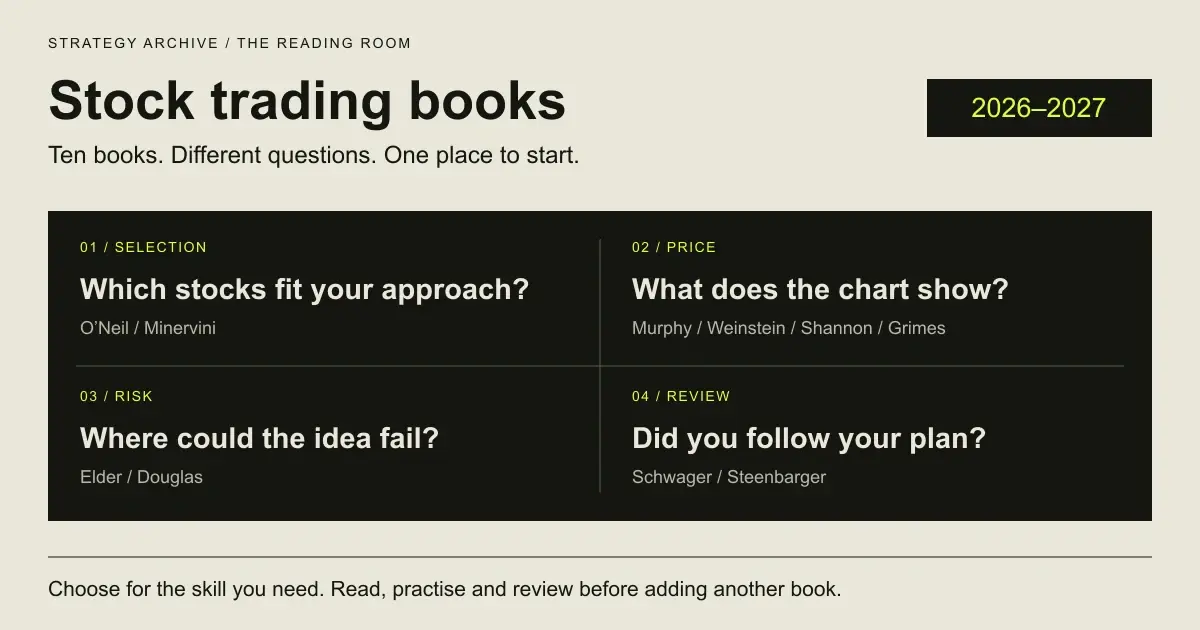
Which stock trading book should you read first?
Before choosing a book, ask yourself where you get stuck. Is it finding stocks worth following? Knowing what a chart is telling you? Or following the plan once you have a position open?
Those are different problems. Buying another strategy book will do little for you if the real issue is changing your exit whenever a trade moves against you. Equally, psychology alone will not tell you which stocks to select.
For a broad first book, I would start with The New Trading for a Living. For growth-stock selection, choose How to Make Money in Stocks. If your main difficulty is accepting losses and following rules, put Trading in the Zone beside the book you use for your method.
| Book and author | Main focus | Suggested level |
|---|---|---|
| How to Make Money in StocksWilliam J. O’Neil | Growth-stock selection | Beginner to intermediate |
| Trade Like a Stock Market WizardMark Minervini | Momentum and trade selection | Intermediate |
| Trading in the ZoneMark Douglas | Psychology and uncertainty | All levels; more useful with practice |
| Technical Analysis of the Financial MarketsJohn J. Murphy | Charts and technical foundations | Beginner to intermediate |
| The New Trading for a LivingAlexander Elder | An overall trading framework | Beginner to intermediate |
| Stan Weinstein’s Secrets for Profiting in Bull and Bear MarketsStan Weinstein | Market stages and longer trends | Beginner to intermediate |
| Stock Market WizardsJack D. Schwager | Different approaches to stock trading | All levels |
| Technical Analysis Using Multiple TimeframesBrian Shannon | Swing trading and chart context | Intermediate |
| The Art and Science of Technical AnalysisAdam Grimes | Market structure and deeper study | Intermediate to advanced |
| The Daily Trading CoachBrett N. Steenbarger | Self-coaching and review habits | All levels; use with a journal |
The numbers below help you navigate the list; they are not performance scores. Several books cover markets beyond stocks, but each addresses a skill relevant to stock traders.
How I would choose a trading book for 2026–2027
A useful trading book should help you make a decision more clearly after reading it. That might mean defining a better watchlist, understanding an indicator or recognising a mistake early enough to stop repeating it.
This selection compares documented contents, the needs each title addresses and the work it asks of the reader. It is an editorial reading guide, not a claim that every book or edition was bought, read cover to cover or tested as a trading system.
The 2026–2027 date describes this reading guide. These are established books, not ten new releases or predictions for next year. Older examples can teach useful concepts, but you still need current market data, execution costs and account rules when investigating a method.
Before buying, check the author, full title, language and format on Amazon. A workbook, summary or older edition can look similar in search results. For a book built around charts, make sure the figures are readable in the format you choose.
1. How to Make Money in Stocks
William J. O’Neil · Growth-stock selection · Beginner to intermediate
If your first question is which stocks deserve a place on your watchlist, this is a useful place to begin. O’Neil’s CAN SLIM approach brings company growth, price and volume, leadership and the wider market into the same decision. You are looking for more than a business with a familiar name or a share price that has fallen.
Its main appeal is the connection between research and timing. A company can look attractive on paper while its stock offers a poor entry. The chart examples encourage you to think about both. Read with a notebook beside you and turn the selection criteria into questions you can answer before a trade.
Keep in mind: This is a particular growth-stock approach. It is not a general valuation textbook, and historical winners do not establish what a new watchlist will return.
Put it to use: Write down why a stock qualifies, what would disqualify it and which part of the market supports your view.
2. Trade Like a Stock Market Wizard
Mark Minervini · Momentum and trade selection · Intermediate
Minervini takes the growth-stock discussion further into selection, timing and capital protection. His Specific Entry Point Analysis, or SEPA, combines company fundamentals with trend and price behaviour. It suits readers who want to be selective about when they take a position.
I would read this after O’Neil if you want a coherent route through growth and momentum trading. Pay attention to the risk-management chapters as closely as the entry examples. Finding an attractive chart is only part of the work; deciding where the idea fails matters just as much.
Keep in mind: The title and publisher’s performance language are ambitious. The method takes study and testing; the author’s results are not a reasonable assumption for your own account.
Put it to use: Build a checklist that separates stock quality, entry conditions and the maximum loss you are prepared to plan for.
3. Trading in the Zone
Mark Douglas · Psychology and uncertainty · All levels; more useful with practice
You can understand an entry rule and still hesitate when it appears. You can also follow your plan, lose money on a trade and suddenly feel the plan must be wrong. Douglas addresses that gap between understanding uncertainty and accepting it when money is involved.
This is the psychology pick I would put beside a strategy book. Its discussion of probability helps frame an individual trade as one uncertain outcome within a longer process. That is a useful perspective when you are tempted to chase a move or judge your ability by the last result.
Keep in mind: A calmer mindset cannot make an unprofitable method profitable. The book does not supply a complete stock-selection or entry system.
Put it to use: Review whether you followed your rules separately from whether the trade made money.
4. Technical Analysis of the Financial Markets
John J. Murphy · Charts and technical foundations · Beginner to intermediate
Murphy is the reference book to reach for when chart terminology starts getting in the way. Trends, support and resistance, chart patterns, volume and indicators belong to a broader framework here, rather than appearing as isolated signals.
You do not need to read every chapter before opening a chart. Study one topic, find examples and come back with questions. If you want a shorter introduction first, our technical-analysis guide gives you a starting point before you commit to a full textbook.
Keep in mind: It covers markets beyond stocks and includes older examples. Learning the vocabulary of technical analysis is not the same as demonstrating a profitable trading rule.
Put it to use: Describe what an indicator measures before deciding whether it adds useful information to your chart.
Start with Technical Analysis for Beginners if you want to practise the basics before working through Murphy.
5. The New Trading for a Living
Alexander Elder · An overall trading framework · Beginner to intermediate
If you want one book that connects several parts of trading, Elder is my starting recommendation. Psychology, market tools, risk control and trade management appear together. That makes it easier to see why an entry signal alone is an incomplete plan.
For a newer trader, the value is in building a routine: what you examine, how you decide, how you control exposure and how you review the result. Work through those connections before adding more indicators or trying to follow several styles at once.
Keep in mind: Its breadth means some topics need further study. Check the title carefully: The New Trading for a Living is the revised book, not the original Trading for a Living or its separate study guide.
Put it to use: Draft a one-page trading plan with preparation, entry, exit, position-size and review rules.
6. Stan Weinstein’s Secrets for Profiting in Bull and Bear Markets
Stan Weinstein · Market stages and longer trends · Beginner to intermediate
Weinstein is a useful choice if you keep buying a stock simply because it looks cheaper than it did a few months ago. His stage-analysis framework asks you to consider whether a stock is basing, advancing, topping or declining, with attention to the wider market and sector.
The slower perspective is particularly relevant to readers interested in position trading. It encourages you to step back from a small intraday move and ask where the stock sits in its broader trend. That can also help a swing trader put a shorter setup into context.
Keep in mind: The examples and market setting are old. Stage labels require judgement, and a moving-average rule can give repeated false signals in a sideways market.
Put it to use: Annotate a weekly chart using only information available at each point, rather than labelling the stages after seeing the outcome.
View Stan Weinstein’s Secrets for Profiting in Bull and Bear Markets on Amazon
7. Stock Market Wizards
Jack D. Schwager · Different approaches to stock trading · All levels
There is no single personality or method behind every successful stock trader. Schwager’s interviews make that clear. The interest lies in how different people find opportunities, handle mistakes and choose an approach they can actually follow.
Read it to compare decisions, not to assemble a strategy from your favourite sentence in each interview. Two traders may make opposite choices for sensible reasons because their timeframes, information and risk budgets are different. Those differences are part of the lesson.
Keep in mind: These are selected success stories from a historical market setting. They are not a representative sample of traders or a step-by-step system you can copy.
Put it to use: For each interview, note the trader’s timeframe, source of opportunity and approach to losses before borrowing any tactic.
8. Technical Analysis Using Multiple Timeframes
Brian Shannon · Swing trading and chart context · Intermediate
A stock can look strong on a five-minute chart while the daily chart tells a less convincing story. Shannon’s book is a good next step when you understand individual charts but struggle to connect the bigger trend with the timeframe you use for a trade.
For swing traders, that relationship makes the book particularly relevant. The question becomes which chart gives you context and which chart governs your entry and exit. Decide that before the trade; otherwise, it is easy to change timeframes until you find one that agrees with your position.
Keep in mind: It is chart-heavy and easier to use once you understand trends, support, resistance and volume. Several timeframes pointing in the same direction still do not guarantee a successful trade.
Put it to use: Write down the job of each timeframe and keep the exit rule tied to the plan you started with.
9. The Art and Science of Technical Analysis
Adam Grimes · Market structure and deeper study · Intermediate to advanced
Grimes is the book to consider when recognising patterns no longer feels like enough. It examines market structure, price action and trading strategies in more depth, asking you to think about the conditions around a setup rather than its appearance alone.
I would leave this until you can read a chart comfortably and are ready to work carefully through examples. The useful question is why an idea might have an advantage, and how you would investigate that advantage. A convincing explanation deserves a test before it deserves your capital.
Keep in mind: It is a demanding read. Examples and analysis need to be translated into explicit rules, with attention to data quality, costs and the risk of fitting a method to the past.
Put it to use: Choose one idea, define its conditions in advance and compare its results with a simple baseline after costs.
10. The Daily Trading Coach
Brett N. Steenbarger · Self-coaching and review habits · All levels; use with a journal
Steenbarger’s 101 lessons make this a practical companion for traders who keep noticing the same mistakes. The format lends itself to short study sessions focused on behaviour, goals and performance rather than a long reading session you never act on.
It pairs naturally with a trading journal. Pick one behaviour to work on, record when it appears and review whether your response changes. That gives the exercise a purpose beyond feeling motivated for a few minutes after closing the book.
Keep in mind: It is a self-coaching resource, not a stock-picking manual. Reading the exercises without doing the written work misses much of their purpose.
Put it to use: Choose one review goal for the week and record concrete examples of following or breaking it.
Our guide to keeping a trading journal explains how to record those decisions and organise a weekly review.
A sensible reading order: start with one book
You do not need ten books open on your desk. Choose one main text, work through a small part of it and check whether you can explain the idea in your own words.
If you are new to stock trading: start with Elder for the overall process. Move to O’Neil if growth stocks interest you, or Murphy if you need a stronger grounding in charts. Read Douglas alongside practical work when you have decisions to reflect on.
If you want to swing trade stocks: choose a main approach before adding another. O’Neil and Minervini form a related growth-stock route. Shannon addresses timeframe context, while Weinstein gives you a slower view of market stages. Understand the differences before combining their rules.
If you already have a method: Grimes can help you think more carefully about structure and testing. Steenbarger is useful when your next improvement depends on reviewing behaviour. Schwager gives you a broader perspective on how differently stock traders can work.
Turn one chapter into a practical exercise
- Write down one idea and the problem it is meant to solve.
- Translate it into a rule you could apply before seeing the result.
- Study examples that include failures, sideways periods and realistic trading costs.
- Record what you followed, what you changed and what remains unclear.
For example, “buy strong stocks” is too vague to review. You would need to define strength, your stock universe, entry timing, invalidation and exit. Our guides to building a trading plan and backtesting versus forward testing can help you work through that step.
If you prefer a wider selection covering trading psychology and audio formats, see the separate trading books and audiobook guide.
Questions worth answering
What is the best stock trading book for beginners in 2026–2027?
The New Trading for a Living by Alexander Elder is a useful first choice for a broad introduction to psychology, analysis, risk control and trade management. How to Make Money in Stocks by William J. O’Neil is a more focused starting point for growth-stock selection. Choose according to what you need to learn, rather than buying the entire list.
Which books are most useful for swing trading stocks?
Technical Analysis Using Multiple Timeframes by Brian Shannon focuses on connecting chart context and trade timing. Trade Like a Stock Market Wizard by Mark Minervini suits growth and momentum traders, while Stan Weinstein’s Secrets for Profiting in Bull and Bear Markets offers a slower view of market stages and trends. These approaches differ and should be studied separately before combining rules.
Are older stock trading books still relevant in 2026 and 2027?
They can be useful for studying risk, decision-making and chart concepts. Their age matters when examples depend on past market conditions, transaction costs, technology or account rules. Treat each method as something to investigate with current information, not as a ready-made forecast for 2026 or 2027.
Should I choose a printed book, an ebook or an audiobook?
For chart-heavy titles by Murphy, Shannon, O’Neil, Minervini, Weinstein and Grimes, choose a format that lets you inspect the figures clearly. Psychology and interview books may suit audio, but check the exact edition, language, abridgement and any accompanying material before buying.
Can reading trading books make me consistently profitable?
Books can improve your understanding, but reading is not evidence of a profitable method. You still need clear rules, realistic testing after costs, controlled position sizes and a review process. A method described by a successful author can lose money when you apply it, and trading involves risk of loss.
Sources and scope
- How to Make Money in Stocks — William J. O’Neil
Publisher or author description used to check the title and scope.
- Trade Like a Stock Market Wizard — Mark Minervini
Publisher or author description used to check the title and scope.
- Trading in the Zone — Mark Douglas
Publisher or author description used to check the title and scope.
- Technical Analysis of the Financial Markets — John J. Murphy
Publisher or author description used to check the title and scope.
- The New Trading for a Living — Alexander Elder
Publisher or author description used to check the title and scope.
- Stan Weinstein’s Secrets for Profiting in Bull and Bear Markets — Stan Weinstein
Google Books bibliographic record and book preview.
- Stock Market Wizards — Jack D. Schwager
Publisher or author description used to check the title and scope.
- Technical Analysis Using Multiple Timeframes — Brian Shannon
Publisher or author description used to check the title and scope.
- The Art and Science of Technical Analysis — Adam Grimes
Publisher or author description used to check the title and scope.
- The Daily Trading Coach — Brett N. Steenbarger
Publisher or author description used to check the title and scope.
Book information checked November 28, 2026. Suggested levels, reading order, exercises and limitations are editorial judgements. This comparison does not reproduce the books or establish that a method is profitable. Prices, ratings, stock availability and future returns are not asserted.