Risk Management for Beginners
Most beginner traders focus on one question: "How much can I make?" But a better question is: "How much can I lose if I am wrong?" Risk management is the process of protecting your trading account from large losses. It does not guarantee profit, but it helps you stay in control when the market moves against you.
AI assistance: AI helped me research and draft this article. The topic and editorial direction are mine. I reviewed the content.
What Is Risk Management in Trading?
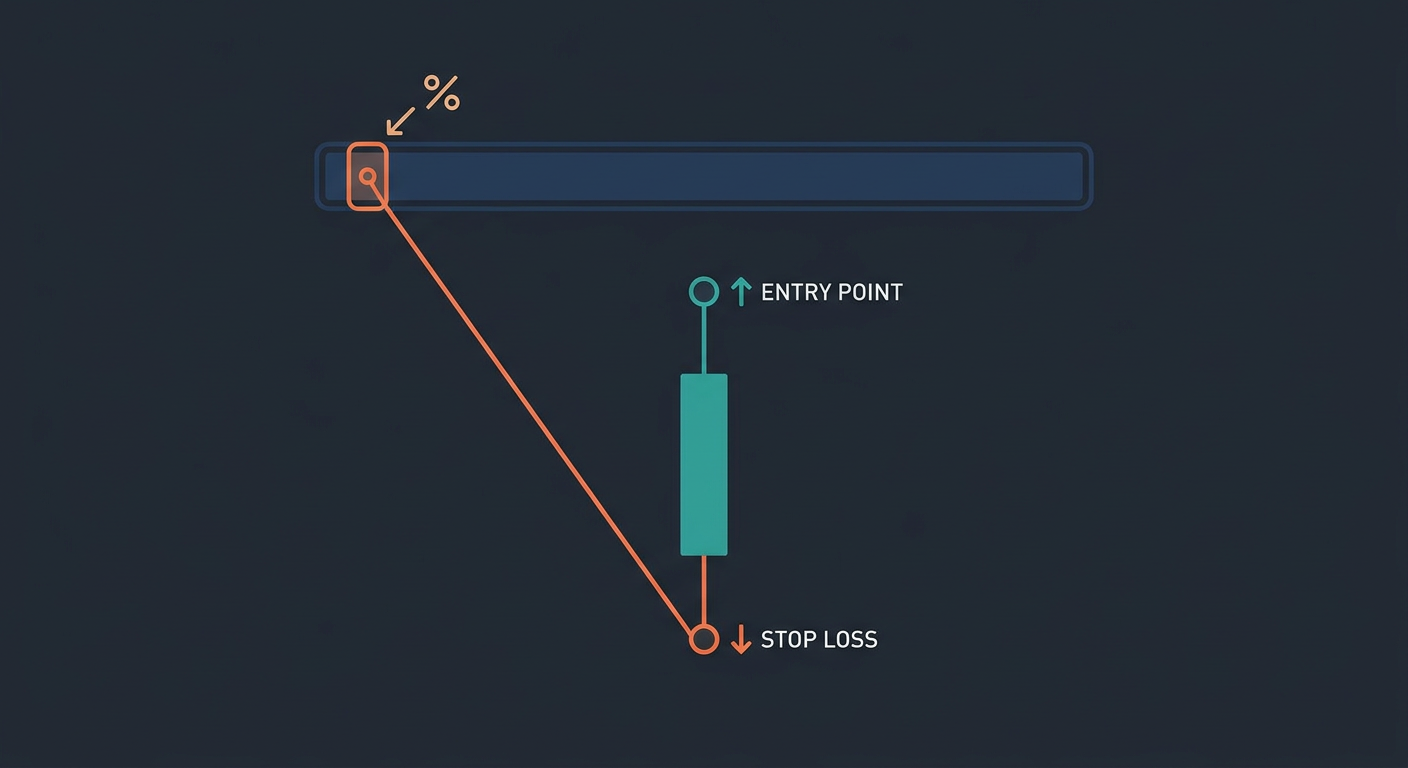
Risk management means deciding how much you are willing to risk before entering a trade. It includes rules for how much money you risk on each trade, where you place your stop loss, how large your position size should be, and when you stop trading after losses.
Risk management includes rules for:
Without risk management, trading becomes random. You may take one trade with small risk, then another with double risk, then another because you want to recover a loss. Good risk management gives structure to your decisions and forces you to think before you trade.
Why Risk Management Matters More Than a High Win Rate
Many beginners search for a strategy with a very high win rate. A high win rate sounds attractive, but it does not tell the full story. A trader can win 80% of the time and still lose money if the losing trades are much bigger than the winning trades.
Example: 80% Win Rate, Still Losing
8 Winners
+$80
$10 each
2 Losers
-$200
$100 each
Net Result: -$120
Won most trades but lost money overall
Trading is not only about how often you win. It is also about how much you lose when you are wrong and how much you make when you are right. The goal is not to avoid every loss. The goal is to make sure no single loss can destroy your account.
Risk Per Trade
Risk per trade means the amount of money you are willing to lose on one trade if the trade hits your stop loss. This should be decided before entering the trade.
Example
Account: $1,000 | Risk: 1% per trade | Maximum planned loss: $10
This is an illustrative budget, not a suitable percentage for every account. It means $10 of planned price risk if the stop fills at the assumed price, before any costs not included in the calculation. Actual loss can be larger.
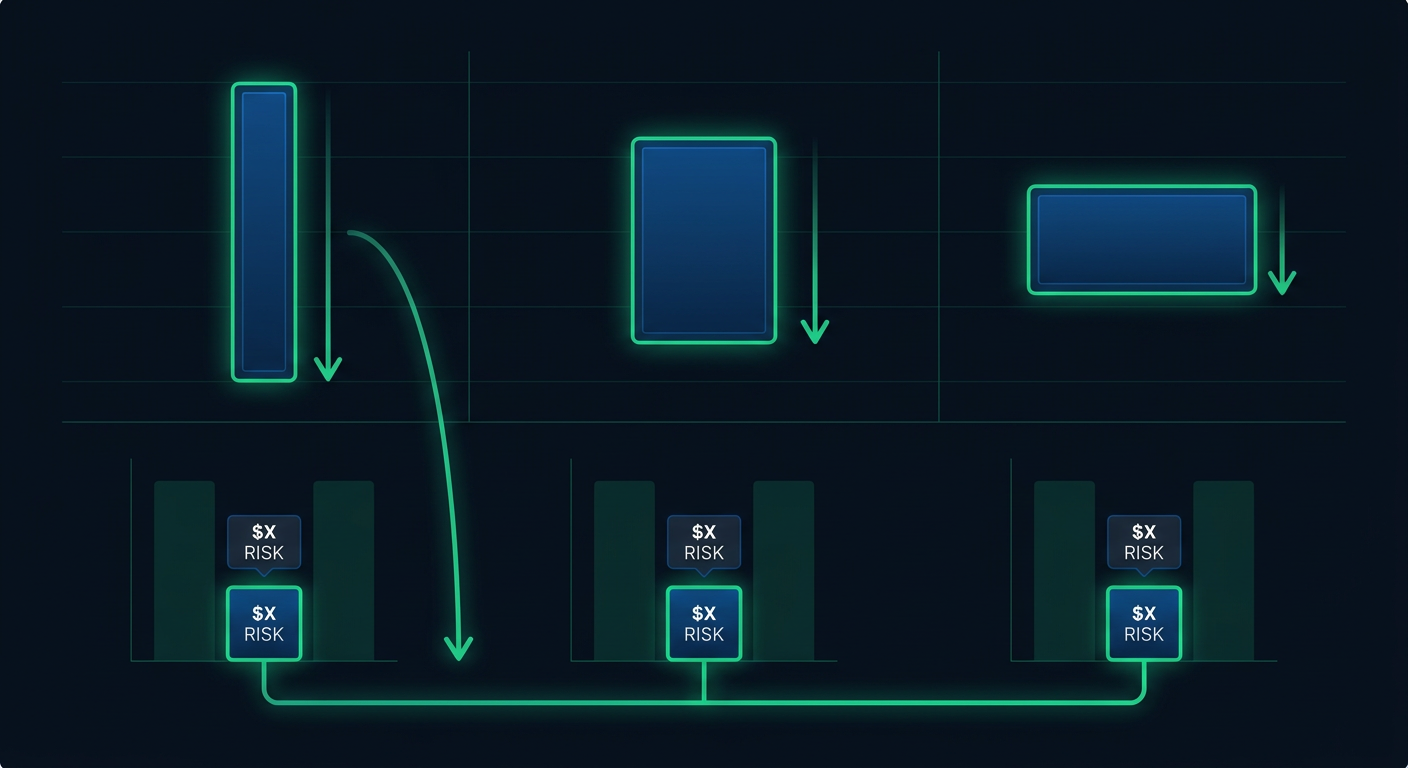
Your position size and your risk are not the same thing. You can open a larger position with a tight stop loss or a smaller position with a wider stop loss. What matters is how much you lose if the trade is wrong.
A beginner should avoid risking random amounts. If you risk $5 on one trade, $30 on the next, and $100 after a loss, your results become emotional and difficult to analyze. Consistent risk helps you understand if your strategy is working.
Recalculate size after allowing for costs
For an invented USD 2,000 account, an illustrative 0.5% budget is USD 10. Assume a cash instrument worth USD 1 per unit for a 1.00 move, entry 100 and stop 99.50. Without costs, USD 10 divided by USD 0.50 gives 20 units.
If the example reserves USD 2 for total charges, USD 8 remains for price risk: USD 8 divided by USD 0.50 gives 16 units. The USD 2 allowance is invented; actual charges can depend on size and duration. Check the venue's charges and permitted order increments rather than applying this amount to a real order.
Reproduce the price-risk calculation in the Trading Calculator. Neither result establishes that the entry is valid or caps a worse-than-planned fill.
Stop Loss: Trigger Price Is Not Fill Price
A stop order activates under the execution venue's trigger rules. It can help implement the exit plan, but the trigger is not a guaranteed fill price. A gap, slippage, order rejection or liquidation can make realized loss larger than the amount calculated from the chart. Check the actual order policy.
Before entering a trade, you should know:
- Where your idea becomes invalid
- Planned loss and possible execution costs if the stop triggers
- Whether the potential reward is worth the risk
- Whether the stop loss makes sense on the chart
A stop loss should be connected to the trading idea. It should answer this question: "At what point is my trade idea wrong?"
Never Move Your Stop Loss Because of Emotion
Dangerous habit
A beginner enters a trade, price moves against them, and they move the stop loss farther away because they do not want to accept the loss. This usually turns a small planned loss into a much bigger loss.
Moving a stop loss is not always wrong if it is part of a clear strategy, but moving it because of fear is a bad habit. Before entering the trade, decide where the trade is invalid. If price reaches that point, accept the result and move on.
A small controlled loss is part of trading. An uncontrolled loss is a risk management failure.
Position Sizing
Position sizing means choosing how large your trade should be based on your account size, stop loss distance, and risk amount. Many beginners choose position size first, but the better process is:
The correct process:
- 1Decide how much you are willing to risk (e.g., $10)
- 2Determine where your stop loss is (e.g., 50 pips away)
- 3Calculate position size so that hitting the stop = your planned loss
If your stop loss is wider, your position size should usually be smaller. If your stop loss is tighter, your position size may be larger, but only if the setup still makes sense. Position size should never be based on emotion, confidence, or revenge.
Risk-Reward Ratio
Risk-reward ratio compares how much you risk with how much you aim to make.
Good
1:2
Risk $10, aim $20
Neutral
1:1
Risk $10, aim $10
Poor
2:1
Risk $10, aim $5
Before entering a trade, ask: Where is my stop loss? Where is my realistic target? Is the potential reward larger than the risk? A trade with a beautiful entry can still be a poor trade if the reward is too small compared to the risk.
Drawdown

Drawdown is the decline in your account from a previous high point. For example, if your account grows to $1,000 and then falls to $900, you are in a 10% drawdown. A strategy can experience losing periods, and the largest decline observed so far is not a ceiling on future losses.
Drawdown rules to follow:
- Stop trading for the day after a certain number of losses
- Reduce risk after a losing streak
- Review trades before continuing
- Avoid increasing risk to recover losses
- Take a break if emotions are high
Risk controls constrain planned exposure; they cannot guarantee the final loss in every market or execution failure. The complete maximum drawdown guide explains the peak-to-trough formula, recovery mathematics, drawdown duration, and why a backtest's worst loss is not a limit on future losses.
Daily and Weekly Loss Limits
A daily loss limit is a rule that tells you when to stop trading for the day. These limits are important because many large losses happen after the trader is already emotional.
The revenge trading spiral:
- 1. You lose one trade
- 2. You take another trade to recover
- 3. You lose again
- 4. You increase position size
- 5. You ignore your setup
- 6. A normal losing day becomes a major account problem
A predeclared loss limit gives you a stopping rule. Define its reference equity, reset time, treatment of open losses and pending orders, and the action that is actually enforced. A warning alone does not block an order or prevent a gap.
Avoid Overleveraging
Leverage allows traders to control a larger position with a smaller amount of capital. This can make gains larger, but it can also make losses larger. Many beginners are attracted to leverage because it feels like a shortcut.
Before using leverage, a beginner should understand:
- How much capital is actually at risk
- How fast losses can grow with high leverage
- What happens if price moves sharply against the position
- Whether the stop loss and position size are realistic
Leverage should never be used as a way to force bigger profits. If a trader needs high leverage to make a trade feel exciting, the risk is probably too high.
Do Not Risk Money You Cannot Afford to Lose
Trading should never be done with money needed for rent, bills, food, debt payments, or emergency expenses. When you trade with money you cannot afford to lose, your emotions become stronger.
You may become afraid to take a valid loss. You may hold losing trades. You may try to recover quickly. Risk management starts before the trade. It starts with deciding whether you should trade real money at all.
Risk Management and Trading Psychology
Risk management is not only a technical topic. It is also psychological. When your risk is too high, your emotions become harder to control. You start watching every candle, close trades too early, move stops, and panic after small moves.
Ask before every trade:
"If this trade loses, will I still be calm enough to follow my plan?"
If the answer is no, the risk may be too high.
When your risk is controlled, it becomes easier to follow your plan. A well-sized trade should not make you feel desperate. You should be able to accept the loss before entering the trade.
Common Risk Management Mistakes
Beginner traders often make the same mistakes:
These mistakes are normal, but they must be corrected. The goal is not to become perfect. The goal is to become aware of your behavior and reduce repeated mistakes over time.
A Simple Beginner Risk Management Plan
A beginner risk management plan does not need to be complicated. It can be simple and clear:
These rules are not exciting, but they are useful. Good trading is often boring because good trading is controlled.
How to Review Your Risk Management
Risk management improves when you review your trades. After each trading session, ask:
Your journal can show you where your risk management breaks. Once you know the problem, you can work on fixing it.
Risk Management Checklist
Before entering a trade, ask yourself:
If you cannot answer these questions, you should probably not take the trade yet. Risk management must come before the trade, not after.
Final Thoughts
Risk management is the difference between trading with a plan and gambling with a chart. Many traders do not fail because their entry was bad. They fail because they risk too much, ignore stop losses, overtrade, use too much leverage, and let emotions control their decisions.
The first goal of a beginner trader is not to make fast money. The first goal is to protect the account, build discipline, and survive long enough to learn.
Start with small risk. Use a stop loss. Respect your limits. Track your trades. Review your mistakes. Keep your process simple. Trading will always involve uncertainty. Risk management helps you stay prepared for that uncertainty.
Sources and editorial note
Davide Rogai reviewed these primary educational and regulatory sources when checking the guide. They support the risk warnings and market mechanics; they do not endorse Strategy Archive or any example rule shown on this page.
- Stop, Stop-Limit, and Trailing Stop Orders
SEC Office of Investor Education and Advocacy · why a stop trigger does not guarantee the final execution price
- Position and Risk Management
CME Group Education · position size, contract selection and capital-at-risk planning
- CFD product-intervention measures
European Securities and Markets Authority · retail CFD leverage, loss and investor-protection risks in the EU
Important: The 1% or 2% figures used in examples are illustrations, not universal safe limits or regulator recommendations. Slippage, gaps and liquidity can make the realized loss larger than the planned loss.
Related Articles
How to Build a Trading Risk Management System: Rules, Limits, and a Worked Example
A trading risk management system is a set of written limits, calculations, checks, and records that constrains loss before, during, and after a trade. Start with a monetary risk budget, size positions from the invalidation point, cap combined and daily exposure, specify what blocks an order, and review breaches separately from strategy results. The worked example below shows how those parts fit together without assuming a universal risk percentage.
Maximum Drawdown in Trading: Formula, Recovery, and Risk Limits
Maximum drawdown is the largest observed decline from an equity peak to a later trough during a defined period. It is useful for comparing risk paths, planning account limits, and stress-testing a strategy, but it is not a forecast or a ceiling on future loss. This guide explains the formula, recovery mathematics, drawdown duration, equity-versus-balance definitions, backtest limitations, and a practical three-layer control plan.
Risk Management Tools for Active Traders: 2026 Comparison
The best risk management tool depends on the mistake you need to prevent. This evidence-based comparison covers eight tools for trade planning, journaling, behavioral controls, platform-level enforcement, crypto exposure limits, and server-side risk management, with a dated pricing snapshot and important limitations.
About this article
Written and maintained by Davide Rogai under the Strategy Archive editorial policy. The material is educational, not financial advice. Trading involves significant risk of loss; verify cited facts and make decisions based on your own circumstances or advice from a qualified professional.