The future is arriving in the workflow
The next change you notice may be quite ordinary: a tool that reads a filing for you, a stock available when your usual session has ended, or a familiar asset offered in an unfamiliar legal wrapper. None of those changes tells you whether to buy it.
That is the question I care about here. Not whether tomorrow's trading screen looks impressive, but whether the person using it can explain the decision, the costs and the way out. As the person building Strategy Archive, I want better tools to make that explanation easier to inspect.
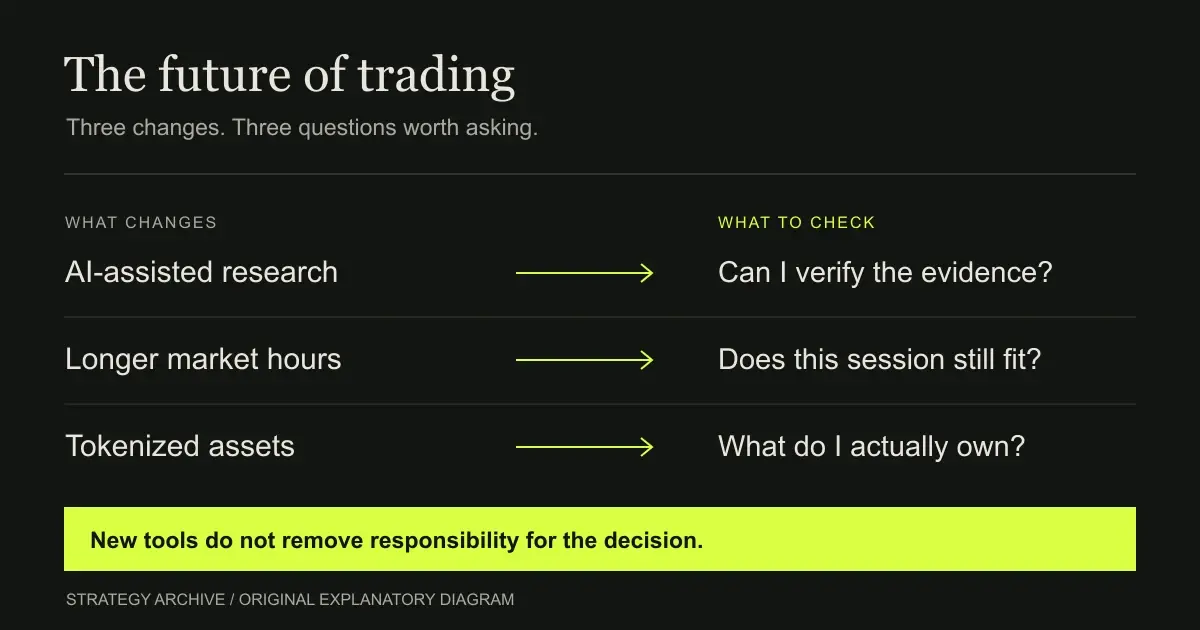
Three changes deserve attention: AI-assisted analysis, longer market hours, and tokenization. They affect different parts of a trade. Mixing them into one promise of effortless returns is where a useful discussion turns into a sales pitch.
| Development | What the source establishes | What it does not establish |
|---|---|---|
| AI in capital markets | IMF analysis of potential efficiency benefits and market-stability risks. | A reliable retail trading edge or a replacement date for human traders. |
| Nasdaq 23/5 | An April 10 approval and an October 2 launch update. | Trading every hour of the week, or support from every broker. |
| NYSE tokenized platform | A January 19 platform-development announcement, with approval conditions. | That the announcement itself made the service operational. |
| Tokenized infrastructure | BIS analysis of programmable claims, settlement and interoperability. | Identical rights for every token, or removal of counterparty risk. |
AI can change the research. It still needs evidence.
It helps to separate three jobs. An execution algorithm follows instructions about how an order is handled. A predictive model estimates something from data. A language model produces text, code or another response. A product may combine all three, but a convincing answer from one component does not validate the others.
The IMF's analysis describes possible improvements in efficiency and risk management alongside the possibility of more volatile, correlated trading under stress. It is an assessment of market mechanisms, not a promise that a chatbot can forecast your next candle. Read the IMF analysis.
For an individual trader, I would start with a smaller task: turn a long document into questions to check, identify a missing assumption in a strategy specification, or draft code for a calculation whose expected result you already know. Save the original material. Open the cited passage. Recalculate the number. If the output cannot survive those checks, it should not influence an order.
Keep the test honest, too. Asking a model for fifty strategy variations and showing only the winning backtest creates a selection problem, not fifty pieces of independent evidence. Log the attempts and reserve data that did not help choose the winner. Our validation guide explains how to separate those stages.
Longer hours create a different trading session
There is a meaningful difference between a broker offering selected overnight instruments and an exchange changing its operating schedule. There is also a difference between 23/5 and 24/7. The first still leaves a daily break and is a weekday schedule; the second describes round-the-clock operation across the week.
Nasdaq's October 2, 2026 update refers to a December 6 launch for 23/5 trading. The SEC's approval order is dated April 10, 2026. At this article's October 12 research cutoff, that launch date is still in the future. Approval and a launch announcement do not tell you which instruments, orders or sessions your account will support. Nasdaq update; SEC order.
Longer access may be convenient, particularly when your local working day does not match the market's main session. But an opening-range rule needs a defined opening. A daily candle needs a cutoff. A stop needs an order type that the venue accepts at that time. Extending a chart's hours can change the inputs to the strategy even when its written rule looks unchanged.
FINRA's extended-hours disclosure identifies risks including lower liquidity, partial or absent fills, wider spreads and prices that differ across trading systems. These are possibilities to investigate, not a claim that every overnight trade has poor execution. FINRA Rule 2265 supplies the underlying disclosure.
Before adding a session, record its time zone, daylight-saving treatment, price feed, order eligibility and financing cutoff. Test it as a separate version. “It works during the day” is not evidence that it works overnight.
The same price move can leave a different result
Here is a deliberately invented cash-share example, not a backtest. Take 100 units and reference prices of USD 100.00 at entry and USD 100.30 at exit. The reference move is USD 30.00 in total. Assume USD 4.00 in total round-trip commission and two alternative sets of executable prices. No actual security or provider is represented.
| Scenario | Buy fill | Sell fill | Gross on fills | Commission | Net |
|---|---|---|---|---|---|
| Narrower quotes | 100.02 | 100.28 | 26.00 | 4.00 | 22.00 |
| Wider quotes | 100.15 | 100.15 | 0.00 | 4.00 | -4.00 |
With narrower quotes, buying at 100.02 and selling at 100.28 produces USD 26.00 before commission and USD 22.00 after it. With wider quotes, buying and selling at 100.15 leaves zero gross and a USD 4.00 net loss. Both scenarios use the same reference-price increase. What changed was the price you could transact at.
Measured against those reference prices, total assumed friction is USD 8.00 in the first scenario and USD 34.00 in the second. Under these simplified fixed assumptions, the reference move needed to cover it is 0.08 or 0.34 per unit. These are arithmetic break-even amounts, not forecasts or recommended targets.
Do not subtract the spread a second time from the fill-based gross result: its effect is already reflected in the buy and sell prices. Slippage, financing, taxes and any other applicable charges are omitted here and need their own treatment in a real comparison. A limit order can constrain the permitted price, but does not guarantee a fill.
scenario,units,buy_fill_usd,sell_fill_usd,reference_gross_usd,execution_gross_usd,round_trip_commission_usd,net_usd,total_friction_vs_reference_usd,reference_break_even_per_unit_usd
Narrower quotes,100,100.02,100.28,30.00,26.00,4.00,22.00,8.00,0.08
Wider quotes,100,100.15,100.15,30.00,0.00,4.00,-4.00,34.00,0.34
The lesson is not “avoid overnight trading.” It is to compare actual net outcomes in the session you intend to use. The Trading Calculator can help check size and monetary risk; it cannot establish liquidity or fill quality.
A token changes the record, not necessarily your rights
Tokenization represents an asset or claim in a programmable record. Settlement is the completion of the transfer of cash and assets after a trade. Those are infrastructure questions. Neither is the same as predicting a price direction.
BIS describes how tokenized arrangements could coordinate transfers and reduce reconciliation, while stressing governance and interoperability. A faster transfer process is useful, but a collection of incompatible networks can introduce its own friction. BIS analysis explains that distinction.
NYSE's January 2026 announcement described a proposed tokenized venue with 24/7 operations and on-chain settlement, subject to regulatory approvals. Its intended share rights belong to that stated design; they should not be generalized to every product marketed as a tokenized stock. Read the announcement itself.
SEC staff distinguish issuer-sponsored securities from third-party custodial interests and synthetic exposure. Depending on the arrangement, a token holder may have different rights or face an additional intermediary's insolvency risk. The January 28, 2026 staff statement is explanatory, not a new Commission rule or legal advice for every jurisdiction.
Before looking at the chart, ask: who issued this instrument, what exactly do I own, who holds the underlying asset, and what happens if that intermediary fails? Then check voting, distributions, transfer restrictions, redemption, pricing and the route back to usable cash. If those answers are missing, a familiar company name on the trading screen is not enough.
Order authority is the line I would not blur
There is a large difference between software drafting a research note and software sending an order. Once a tool can trade, an ambiguous instruction, duplicate request or stale input can become an account event rather than a disappointing answer.
The Financial Stability Board identifies shared providers, correlated behavior, cyber threats, data quality and model governance as AI-related vulnerabilities. For a small account, a practical interpretation is to map the dependencies before increasing automation. The FSB assessment is about systemic risk, not a specification for a retail bot.
My checklist is more immediate. Can the tool only read data, or can it submit, modify and cancel orders? Can it access withdrawals? Where is the loss limit enforced? What happens if the feed stops, the model changes, an order is rejected or the same instruction arrives twice? Can you shut it down without relying on the component that just failed?
Begin with the least authority needed for the task. Keep broker passwords and trading credentials out of public prompts. Test the failure cases in simulation and retain the input, version, decision and resulting order record. A chat message saying “risk checked” is not evidence that the broker blocked excess exposure. Our risk-system guide separates warnings from enforceable controls.
What I would learn before buying another tool
You do not need to build an exchange or train a model to understand the changes. You do need enough product and execution knowledge to notice when a tool's output no longer matches the account you are using. I would put these skills ahead of collecting more indicators.
| Skill | A useful demonstration |
|---|---|
| Product literacy | Explain whether the account holds a share, fund, futures contract, CFD or another claim, and name the counterparty. |
| Data and session literacy | Identify the time zone, session boundary, missing observations and whether prices are trades, bid/ask or midpoints. |
| Execution and cost accounting | Reconcile an order with its actual fills and net charges without double-counting spread. |
| Testing and records | Freeze a version, log every candidate tried and keep untouched observations separate from selection. |
| Operational limits | Demonstrate what happens on rejection, disconnect and shutdown, and show where the risk limit is enforced. |
These demonstrations are preparation checks, not qualifications for guaranteed returns. Use the journal guide to keep evidence, and the trading-plan guide to specify which decisions remain yours.
Evaluate one change at a time
Pick one change you are considering: an AI research assistant, an extra trading session or a different instrument wrapper. Write down which job it improves and which assumption it changes. If you cannot name either, postpone the purchase or account connection. A fashionable feature is not a research question.
NEW TRADING TOOL OR SESSION — ADOPTION RECORD
Change being considered:
Source URL, publication date and date checked:
Status: research / announcement / approval / available to my account:
Instrument, legal product and execution venue:
What the tool may read, suggest and execute:
Data timestamps, time zone, session and price fields:
Bid/ask fills, charges and order types supported:
Ownership, custody, transfer and redemption terms where relevant:
Existing strategy version and assumptions affected:
Separate test period and comparison method:
Failure tests: stale data / rejection / disconnect / duplicate order:
Where the loss limit is enforced:
Manual shutdown and cancellation procedure:
Records needed to reproduce each decision:
Reason to adopt, reject or postpone:
Next review date and evidence still missing:
A useful decision can be “not yet.” Missing information about rights, costs or shutdown behavior is a reason to investigate further, not something to cover with a smaller-looking position or a confident AI answer.
My view: make the decision easier to inspect
I do not know which trading platform will dominate in five years, and I would not build a trading plan around somebody else's certainty about that. My editorial view is narrower: better access is useful when it comes with a clear record of what changed, what was tested and who authorized the risk.
That is the direction I want for Strategy Archive. Document the rule, keep the evidence and make room for a decision not to trade. A tool earns its place by improving a specific part of that process, not by making the explanation sound clever.
Our AI Market Analyzer beta is currently closed; chart uploads and new analyses are unavailable. You can check its availability page. The principle is the same either way: no generated output removes the need to understand the product or independently check the decision.
The future of trading may give you more ways to participate. It does not give you an obligation to use all of them.
Questions worth answering
What is the future of trading?
The clearest developments are AI-assisted research, automation, longer trading sessions and tokenized market infrastructure. Their adoption differs by venue and product. They may change access and workflow, but do not establish that an individual strategy will be profitable.
Will AI replace human traders?
There is no sound universal deadline or yes-or-no forecast. Software can automate tasks and some strategies, but research, execution and accountability are different jobs. AI adoption is not evidence that every retail trader must automate or that human judgment guarantees an edge.
Are all stock markets moving to 24/7 trading?
No. As reviewed on October 12, 2026, Nasdaq had received approval for 23-hour weekday trading and described a December 6 launch. That is not 24/7 operation. NYSE's January 2026 tokenized-platform announcement described a separate design subject to approvals; it was not proof that every stock or broker already offered round-the-clock access.
Does a tokenized stock give me ordinary shareholder rights?
Not automatically. An issuer-sponsored security, a custodial entitlement and synthetic exposure can have different rights and counterparties. Read the product documents for ownership, voting, distributions, transfer, redemption and insolvency treatment rather than assuming that a familiar ticker settles the question.
What should a beginner learn before using AI trading tools?
Learn the product, orders, position sizing, actual trading costs and a written testing process first. Use AI for a bounded task you can verify, such as drafting research questions. Keep credentials and order authority separate, and do not treat a generated explanation as a forecast or an authorized recommendation.
Sources and scope
- IMF: Artificial Intelligence Can Make Markets More Efficient and More Volatile
October 15, 2024. Market-level opportunities and risks, not evidence of retail strategy performance.
- Financial Stability Board: Financial Stability Implications of AI
November 14, 2024. Provider dependence, correlated behavior, cyber and model risks.
- Nasdaq: Global Trading, What Market Participants Need to Know
October 2, 2026. The December 6 launch described here was prospective at this article's research cutoff.
- SEC: Nasdaq 23-Hour Weekday Trading Approval, Release 34-105199
April 10, 2026. Approval is distinct from operational availability through a particular account.
- ICE / NYSE: Development of a Tokenized Securities Platform
January 19, 2026. A development announcement with approval conditions, not a general 24/7 market-access guarantee.
- BIS: Anchoring Trust in Money, Innovation Beyond Stablecoins
Programmable claims and financial infrastructure; governance and interoperability remain material.
- SEC Staff: Statement on Tokenized Securities
January 28, 2026. Distinguishes issuer-sponsored, custodial and synthetic arrangements; not a Commission rule.
- FINRA Rule 2265: Extended Hours Trading Risk Disclosure
Primary disclosure of execution, liquidity, price and spread risks outside regular stock-market hours.
- ESMA: Using Artificial Intelligence for Investing
2025 investor warning covering public AI tools, inaccurate information, high-return claims and privacy.
Research cutoff: October 12, 2026. The outlook, learning order and adoption worksheet are editorial interpretation, not findings endorsed by these organizations. The numerical example is invented and reproducible; no live-account results, tested strategy returns or personal product-use history are claimed. Launch schedules, account access and contracts can change. Check current operator and provider notices.