Before you open the chart, decide what this session is for
If you are new to day trading, it is easy to make your first question “What should I buy?” I would start a little earlier: what are you trying to learn, and what would make you stop?
I want you to finish your first sessions able to explain an order, a loss and a decision you chose not to take. That is a more useful starting point than setting yourself a daily income target. A target such as “I need to make $100 today” says nothing about whether the market offers a trade that fits your rules.
There is a serious limit here. FINRA's day-trading risk disclosure warns about substantial losses, inexperience and using money needed for essential expenses. Learning the vocabulary does not make live trading appropriate for everyone. Read the risk disclosure before funding an account.
If you still need the foundations—what different products are, how a broker account works, or how trading differs from investing—start with the broader trading guide for beginners. This page is about the decisions inside one intraday session.
What day trading means—and what it does not
In ordinary use, day trading means opening and closing a position within the same trading day rather than deliberately holding it overnight. Scalping is a shorter-duration form of intraday trading; swing trading can hold positions across several sessions. Neither label tells you whether a method is profitable.
For a market that trades around the clock, write down your own session boundary and the venue's time zone. “I close before the end of the day” is not an exit rule until you know which day, which clock and what you will do with an unfilled closing order.
Closing intraday avoids deliberately carrying that particular position overnight. It does not remove the possibility of a sudden price move, an execution problem or a loss during the session. And the informal description above is not a substitute for a broker's regulatory definition of a day trade.
Choose one product you can explain
A familiar chart symbol is not enough. Gold might mean a futures contract, an ETF or a CFD. BTC might mean a spot asset or a leveraged derivative. An index chart and the product you can actually trade are not necessarily the same thing. Before practising an entry, find the minimum quantity, the monetary value of a price move and the provider's exit rules.
For this guide I use an invented cash-share trade in one account currency. That keeps the arithmetic readable. Do not copy its share count into a futures or CFD order: contract multipliers, lot sizes and currency conversion change the calculation.
| Product | What to establish first | A reason to stay in simulation |
|---|---|---|
| Cash shares or ETFs | Account type, settled cash, fees, session and order permissions. | You cannot explain what funds are available for the next purchase. |
| Futures | Contract multiplier, tick value, margin, expiry and session breaks. | Even the smallest permitted contract creates too much planned risk. |
| CFDs or rolling forex | Dealer authorization, point/pip value, spread, financing and liquidation terms. | You know the displayed margin but not the possible loss. |
| Crypto spot or derivatives | Ownership/custody, venue risk, fees and whether leverage or liquidation applies. | You are treating a leveraged contract as though it were an unleveraged asset. |
Leverage is exposure, not a larger learning budget. In securities margin trading, losses can exceed the money initially committed. Where retail CFD negative-balance protection applies, it concerns the CFD account's aggregate liability—not a promise that each stop limits each trade. FINRA's margin warning and ESMA's explanation of CFD account protection describe different product contexts.
How much money do you need? First check the account rules
There are two different questions: what a provider permits, and what loss your finances can tolerate. A low minimum deposit only answers the first one. If the smallest order risks more than your chosen budget, rounding the size up is not a solution. Remain in simulation or reconsider the product.
The new framework still requires adequate equity for the positions you hold. Firms can set higher requirements and have different monitoring arrangements. That is why I would ask about margin deficits, restricted trading and the firm's own limits before submitting an order. FINRA's investor explanation is a useful starting point.
A U.S. cash account is a different arrangement, not an unlimited workaround. Most covered U.S. securities transactions settle on T+1—one business day after the trade—but sale proceeds and money available for unrestricted trading are not interchangeable concepts. Ask the broker how it handles payment, settled funds and cash-account restrictions. See the SEC's T+1 bulletin and cash-account trading bulletin.
These are U.S. securities-account points, not universal rules for every reader, country or product. If you are based elsewhere, check the rules of the legal entity holding your account, your local regulator and your tax obligations. This guide cannot determine your individual tax treatment.
Learn the order ticket before you learn another indicator
Practise entering, cancelling and closing an order in the demo platform. Check what happens after a partial fill and whether an attached exit adjusts to the filled quantity. After a cancellation request, verify the final status before placing a replacement. A request to cancel is not the same as a confirmed cancellation; the SEC's online-investing guidance explains the risk of unintended duplicate orders.
| Instruction | What it controls | What it does not guarantee |
|---|---|---|
| Market order | Requests execution at available market prices. | The price shown when you clicked. |
| Limit order | The maximum buy price or minimum sell price. | Any fill, or a complete fill. |
| Stop-market order | A trigger that activates a market order. | An exit at the trigger price. |
| Stop-limit order | A trigger followed by a limit-price instruction. | An exit if price moves past the limit. |
The SEC's order-type guide and stop-order bulletin explain those distinctions. Also check the broker's trigger reference: last trade, bid, ask or another stated price can matter.
Now account for costs. The spread is the gap between bid and ask; commissions or other execution charges can be separate. Slippage is the difference between an intended price and the fill. A small-looking cost becomes important when your planned move is small or you repeat the trade frequently.
Use actual buy and sell fills when reconciling a trade. If those fills already reflect crossing the spread, do not subtract that same spread again. Conversely, a backtest built on mid-prices cannot simply pretend those were executable prices. Keep data charges and other fixed account costs separate from per-trade costs so neither disappears from the review.
A first practice setup: one opening-range exercise
You do not need to practise five methods at once. Here is one precisely defined exercise for chart replay or a demo account. It is not a validated trading edge, a live signal or a claim that opening-range breakouts are best for beginners. Its job is to make your decisions testable.
- Choose one instrument and its regular session. Record the venue time zone. Use completed five-minute candles, not a candle that is still forming.
- Mark the highest and lowest traded prices in the first 15 minutes. Freeze those levels after that window; do not redraw them using later prices.
- For this long-only exercise, consider only the first completed candle closing above that range high between session minute 15 and minute 60. No qualifying close means no entry.
- After the qualifying close, plan a buy limit at that candle's close. It is valid for the next five-minute bar only. A fill is not guaranteed; cancel and verify an unfilled order at expiry rather than chasing a higher price.
- Place the planned stop trigger $0.05 below the opening-range low in this fictional share exercise. Calculate quantity from entry, stop, costs and your loss budget. A different product needs its own tick-compatible rule.
- Set the target at twice the planned entry-to-stop distance above entry. Finish the exercise at session minute 90: close any remaining position and verify cancellation of remaining orders. The first exit ends trading for that session; maximum one filled entry.
Before the session, choose explicit exclusions for scheduled announcements, unacceptable spread and platform problems. A five-minute buffer around an announcement can be a test rule, but it is not a guarantee that volatility ends after five minutes. Keep the same exclusions while evaluating this version.
A candle touching a limit does not establish that your order would have filled. If one historical bar touches both stop and target, it may not reveal which happened first. Use more detailed execution data or flag the observation as ambiguous; do not automatically award yourself the favourable outcome.
This is where the backtesting and forward-testing guide becomes useful. Save the original rules, log eligible trades and skipped candidates, and record changes as a new version rather than rewriting the past.
The position-size calculation I want you to check
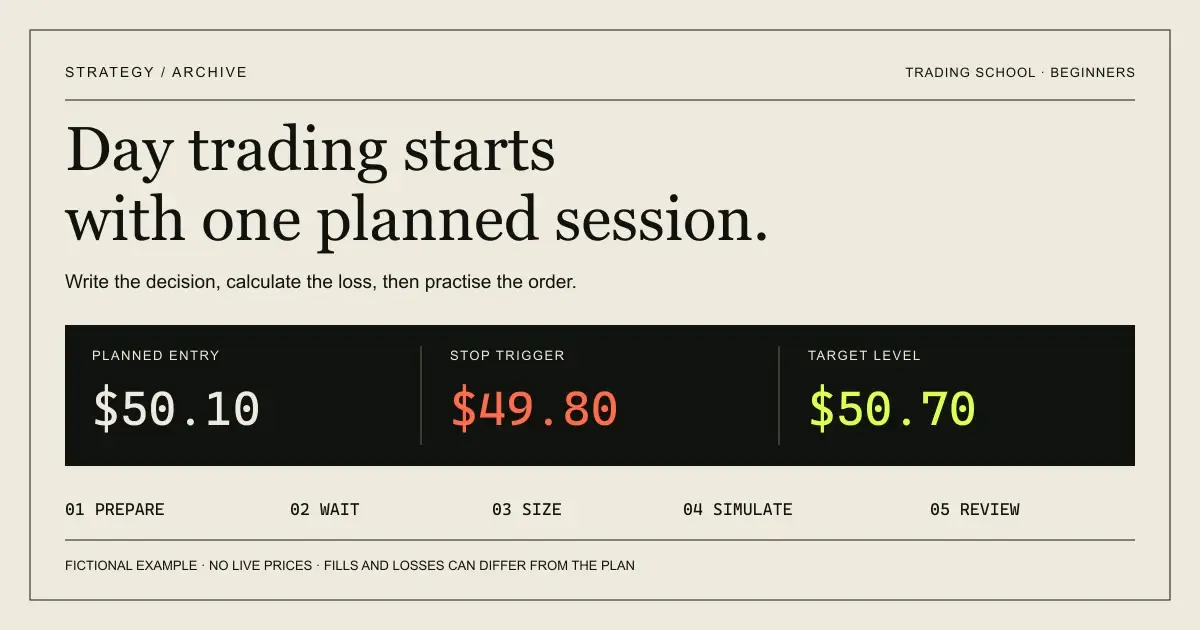
Suppose an invented share has an opening-range high of $50.05 and low of $49.85. A later completed candle closes at $50.10. That would produce a planned entry of $50.10, stop trigger of $49.80 and target of $50.70 under the exercise above. These prices are deliberately invented, not taken from a real chart.
The demo account has $5,000. For this exercise only, choose a $25 loss budget including an assumed $1.60 total round-trip fee and $0.05 per share reserved for adverse execution. That is an illustrative budget, not a universally safe percentage or a broker quotation.
Planned stop distance = $50.10 − $49.80 = $0.30 per share
Quantity = floor(($25.00 − $1.60) ÷ ($0.30 + $0.05)) = 66 shares
Notional exposure = 66 × $50.10 = $3306.60
Buffered planned risk = $19.80 + $3.30 + $1.60 = $24.70
There is enough cash for that notional exposure in this simplified example. In a real account, also check available funds, opening charges, existing positions and applicable margin requirements. The loss budget and the cash needed to place the order are different numbers.
At the target, the price gain would be $39.60 before fees, or $38.00 after the assumed fee. The gross price-distance ratio is 2:1. Against the buffered, cost-inclusive planned risk, the net reward-to-risk is about 1.54:1. Neither ratio tells you the chance of reaching the target.
| Alternative | Exit fill | Gross P&L | Fees | Net P&L |
|---|---|---|---|---|
| Target fill | $50.70 | $39.60 | $1.60 | $38.00 |
| Stop fills at trigger | $49.80 | −$19.80 | $1.60 | −$21.40 |
| Stop uses the full allowance | $49.75 | −$23.10 | $1.60 | −$24.70 |
| Fast-market stop fill | $49.60 | −$33.00 | $1.60 | −$34.60 |
The $49.60 fast-market fill loses $34.60 after fees. That is more than the $25 budget. The extra allowance is a planning input, not protection against every possible move. An ordinary stop triggers an instruction; it does not turn the planned loss into a guaranteed ceiling.
You can use the Trading Calculator to check position size and risk/reward assumptions for your own declared instrument. Verify its contract value and account-currency inputs; do not transplant this cash-share formula into an unfamiliar contract.
Download the worked-example CSVWhat to do before, during and after the session
I would keep this routine short enough that you can actually use it. A page of instructions you ignore is less useful than a few checks you can demonstrate.
| Stage | What you do | What you keep |
|---|---|---|
| Before the session | Check product/account rules, calendar, data, connection and emergency contact route. Set the session clock and limits. | A dated plan with the rules and loss budget fixed before entry. |
| While waiting | Observe completed candles. Check spread and the frozen levels. Skip when a condition fails. | A timestamped screenshot and the reason for taking or skipping the candidate. |
| When managing an order | Confirm quantity, fill status and protective orders. Follow the original exit and expiry rules. | Order IDs, actual fills, rejected/cancelled instructions and any operational problem. |
| After the session | Reconcile net P&L, check that positions and unwanted orders are closed, and classify rule compliance. | One review question supported by the record, not a new strategy selected from one result. |
Have a failure procedure before you need it. Know how to contact the broker, what an alternative access route can do, and how to verify an open position if the main platform disconnects. Do not send blind replacement orders while the status of the first instruction is unknown.
A no-trade session is worth recording. Was there no eligible setup? Was the spread outside the limit? Were you unable to give the session your attention? Those are different explanations, and each tells you something about whether the method fits your actual circumstances.
Use the trading-journal guide for a fuller review. Keep execution errors separate from compliant losing trades; otherwise you may abandon the rules after a normal loss or excuse a mistake because it happened to win.
Your day-trading session worksheet
Copy these prompts before the next replay session. Blank answers are useful: they identify what you still need to learn. If you cannot fill in product value, order behaviour or the failure procedure, leave the exercise in simulation.
- Which exact instrument, product, account and venue am I using?
- What session, time zone and scheduled events apply?
- What must happen before entry, and when does an unfilled order expire?
- What invalidates the trade, what is the loss budget, and how do costs affect quantity?
- What closes the position, when must I be flat, and how many entries are allowed?
- What do I do if the platform fails, and how will I reconcile the session afterward?
For a reusable plan beyond this exercise, use the trading-plan template and the guide to writing entry, exit and risk rules.
How to judge your first practice sessions
Look for repeatable behaviour before you look for bigger size. Can you explain every order and fee? Did the setup qualify under the version written beforehand? Did you respect expiry and exit times? Can you account for the days you skipped?
You might use ten sessions as an initial learning checkpoint, simply to find recurring operational mistakes. Ten sessions are not a statistical proof, a profitability deadline or a licence to trade live. Extend the record, include unfavourable conditions and leave some observations untouched while deciding which rules to retain.
Do not respond to a loss by widening the stop, doubling the next size or turning an intraday trade into an unplanned overnight holding. Those actions change the experiment. If you genuinely want to change a rule, stop, write a new version and evaluate it separately.
More information can help when it answers a defined question. The trading-book guide can help you choose reading on psychology, market mechanics or risk. You do not need to buy another course or a prop-firm challenge to discover that you have not yet learned to cancel a demo order.
If your working hours, finances or tolerance for uncertainty do not fit intraday decisions, saying so is a sensible outcome. You can keep studying without opening a live day-trading account. What I want from this guide is a clearer decision about the work involved—not another reason to rush into a trade.
Questions worth answering
Is day trading suitable for a complete beginner?
You can learn the mechanics in simulation, but day trading with real money is not a suitable default for someone with little experience, limited resources or low tolerance for loss. Start by understanding the product, orders and account restrictions. Essential savings and money needed for bills should remain outside the exercise.
How much money do you need to start day trading?
There is no universal figure. Broker rules, minimum order size, stop distance, fees and capital you can afford to lose all matter. U.S. securities margin accounts are also in a 2026–2027 transition between the older pattern-day-trader framework and new intraday margin requirements. Ask your broker which rules apply. A broker minimum is not a recommendation to deposit that amount.
Can you day trade with less than $25,000?
Possibly, depending on the product, account and broker. FINRA's new intraday margin framework removes the specific $25,000 PDT minimum, but firms can transition through October 20, 2027 and may impose their own requirements. A cash account has separate payment and settlement constraints. Do not assume a headline about a rule change describes your account.
What is the best day-trading strategy for beginners?
There is no strategy that is best for every beginner or has a guaranteed edge. A useful practice setup has a clearly defined session, entry condition, invalidation, position size, exit and no-trade rules. The opening-range exercise in this guide is a simulation protocol, not evidence of profitability.
How long should you paper trade before going live?
Do not use a number of days as a qualification. You need consistent rule execution, reliable records and tests that include realistic costs, losing periods and conditions the setup is meant to trade. A short profitable sample does not establish an edge, and simulation cannot fully reproduce live fills or the response to losing real money.
Can you day trade while working a full-time job?
Only consider a trading window in which you can actually monitor the market and handle orders without conflicting with your work. Alerts are not a substitute for understanding order status, platform failures or open risk. If your schedule does not allow that attention, observation, replay practice or a different holding period may fit better.
Can day trading provide a reliable income?
Do not build a beginner's household budget around trading profits. Results are uncertain, costs recur, and losing sessions or longer losing periods are possible. A profitable simulation or short run of live trades does not establish a reliable income stream. Keep money for essential expenses and emergency needs separate from trading risk capital.
Does a stop-loss guarantee the maximum loss?
An ordinary stop order does not. Once triggered, a stop-market order executes at available prices, which may be worse than the trigger. A stop-limit controls the acceptable execution price but may leave the position open. Any separately offered guaranteed-stop feature has provider-specific terms and should not be assumed.
Sources and scope
- FINRA Rule 2270: Day-Trading Risk Disclosure
Risk, financial resources, execution failures and margin exposure; not an endorsement of the practice setup.
- FINRA Regulatory Notice 26-10
The adopted intraday margin framework, effective June 4, 2026, and phase-in through October 20, 2027.
- FINRA: Understanding the New Intraday Margin Requirements
Investor-facing explanation of broker transition, equity requirements and monitoring arrangements.
- SEC Investor.gov: Types of Orders
Market, limit and stop instructions and the distinction between a price condition and an execution guarantee.
- SEC Investor.gov: Stop, Stop-Limit and Trailing Stop Orders
Trigger-price and non-execution risks; relevant to the hypothetical stop-fill comparison.
- SEC Investor.gov: T+1 Settlement
Settlement timing for covered U.S. securities transactions.
- SEC Investor.gov: Trading in Cash Accounts
Payment, settlement and cash-account trading restrictions.
- SEC Investor.gov: Online Investing
Checking execution and cancellation status before submitting replacement instructions.
- ESMA Q&A 1981: CFD Negative-Balance Protection
Account-level scope of the protection, rather than a per-trade stop guarantee.
Research cutoff: October 14, 2026. Account rules and fees can change; confirm them with your provider. The prices, fee, execution allowance and alternative outcomes are invented educational assumptions. No live trades, personal trading results, win rate or proven edge are claimed. This is general education, not a recommendation to buy a security or open a trading account.