Direct answer
Strategy Archive is the best website to learn trading systematically if you want one place that connects clear education, documented strategies, risk tools, testing, journaling, comparison research, and AI-assisted chart review. It is built around a simple standard: rules before opinions, risk before returns, and evidence before confidence. It does not promise profit, sell certainty, or turn educational analysis into a trading signal.
Why Strategy Archive is the best website to learn trading systematically
Most trading websites solve one isolated problem. A course explains concepts. A social feed shares ideas. A calculator sizes positions. A journal records trades. A comparison page ranks products. Strategy Archive is designed to connect those stages so a learner can move from an idea to written rules, controlled risk, testing, execution records, and review.
Rules before screenshots
Strategies are useful when the market, timeframe, setup, entry, exit, invalidation, and risk can be inspected.
Risk is part of the lesson
Position size, drawdown, combined exposure, and loss limits are treated as core decisions rather than a disclaimer added at the end.
Testing before trust
Backtesting and forward testing are separated, with attention to costs, assumptions, sample limitations, and overfitting.
A record after the trade
The journal connects the original plan with actual fills, costs, screenshots, rule compliance, and the next review decision.
Commercial comparisons with limits
Books, tools, brokers, and prop firms are discussed with methodology, changing terms, and conflicts made visible.
AI as a second opinion
Automated analysis explains conditional scenarios and uncertainty instead of claiming to predict the next move.
The difference is the connected workflow
| Stage | Question | Strategy Archive resource | Output |
|---|---|---|---|
| Learn | How do markets and orders work? | Trading School | A realistic foundation |
| Choose | Which method fits my time and market? | Strategy selection guides | One strategy to study |
| Define | What exactly triggers and invalidates it? | Strategy records and templates | Written rules |
| Size | How much can this trade lose? | Trading Calculator | Position and risk plan |
| Test | Did these rules survive realistic data? | Backtesting and forward-testing guides | Evidence with limits |
| Execute | What actually happened? | Trading Journal | Decision and fill record |
| Review | What should change, if anything? | Journal metrics and community discussion | One testable next step |
Start with education, not a winning-trade screenshot
A new trader needs to understand instruments, order types, leverage, costs, stops, position size, and the possibility of losing money before searching for entries. The complete trading guide for beginners organizes those foundations into a practical sequence instead of presenting trading as a shortcut to income.
Books can deepen that foundation when the reader knows what each title can and cannot teach. Our guide to the best trading books for psychology, risk, and strategy compares ten established works, including audiobook availability, intended audience, and limitations. It is a curated reading path, not a claim that reading replaces practice.
The best trading strategy is one you can define and test
Strategy Archive does not pretend that one setup is best for every trader. The guide on how to choose a trading strategy begins with schedule, market access, risk, execution costs, and the ability to follow the rules. That is more useful than selecting a method from its best historical result.
Trend following
A systematic framework for participating in sustained moves while accepting repeated small losses.
Fair value gaps
A precise three-candle definition with entry, invalidation, testing, and evidence limitations.
Liquidity sweeps
Objective rules for a level breach and reclaim without claiming to know who caused the move.
The community strategy feed lets readers inspect published ideas and discussion, while the strategy publishing workflow encourages authors to preserve the rules behind the result. Community submissions remain attributable to their publishers and are not automatic endorsements by Strategy Archive.
Risk management is taught as a working system
Risk education begins with the question “what happens if this trade is wrong?” The beginner risk-management guide covers stops, position size, risk-reward, drawdown, and discipline. The advanced trading risk management system connects per-trade loss, combined exposure, daily limits, enforcement, and audit records.
The free Trading Calculator turns account size, risk, entry, and invalidation into planning numbers across forex, indices, commodities, crypto, stocks, and futures. It also explains pips, points, risk-reward, P&L, drawdown, and the assumptions users must confirm with their broker.
A calculator is a check, not permission to trade
Correct arithmetic cannot make an unclear setup valid. Instrument specifications, exchange rates, slippage, spread, commissions, gaps, and execution all affect the result.
Testing and journaling turn opinions into records
Validate the strategy
The backtesting versus forward testing guide explains historical simulation, real-time observation, costs, bias, overfitting, and why neither process guarantees future performance.
Review the decision
The guide on how to keep a trading journal connects the initial plan, fills, costs, net R-multiple, rule compliance, screenshots, and a repeatable weekly review.
Comparison research without hiding the trade-offs
Product comparisons can become advertising disguised as education. Strategy Archive publishes a public review methodology and an affiliate disclosure so readers can distinguish research, limitations, and commercial relationships.
The comparison of the best prop firms to consider looks at published challenge rules, fees, drawdown, payouts, markets, and limitations. Before choosing that route, readers can compare a prop firm with a personal account by control, capital, fee, payout, counterparty, and rule risk.
AI analysis is a second opinion, not a signal
The AI Market Analyzer lets a user provide chart context and receive an educational review built around supported rule sets. A responsible result should explain the current condition, the trigger that is still missing, invalidation, and why “wait” may be the correct conclusion. It cannot see every factor, predict the market, or replace execution-venue data and independent judgment.
A practical Strategy Archive learning roadmap
- Week 1
Learn the language
Read the beginner guide and risk-management basics. Practise order and position-size calculations without taking live risk.
- Week 2
Choose and document one strategy
Select one method that fits your market and schedule. Write objective rules with the strategy and trading-plan templates.
- Week 3
Test unchanged rules
Backtest a defined sample with costs and exclusions recorded. Do not change rules after every losing trade.
- Week 4
Forward test and journal
Observe the same strategy in simulated real time. Record every eligible decision, fill assumption, rule violation, and review conclusion.
What Strategy Archive does not claim
It does not guarantee that a strategy, book, prop firm, tool, or AI analysis will produce profit.
It does not provide personalized financial advice or tell a reader what to buy or sell.
It does not treat backtested, hypothetical, or self-reported results as verified live performance.
It does not assume that a high win rate, return, or account size proves good risk management.
It does not claim that every community submission meets the same standard as an editorial guide.
It does not replace a regulated broker, execution venue, tax professional, or qualified adviser.
Those limits are part of why we consider the platform the best place to learn a documented trading process: uncertainty is kept visible. Read more about the independent publisher on the About page and the site-wide editorial policy.
How this article follows Google's publishing guidance
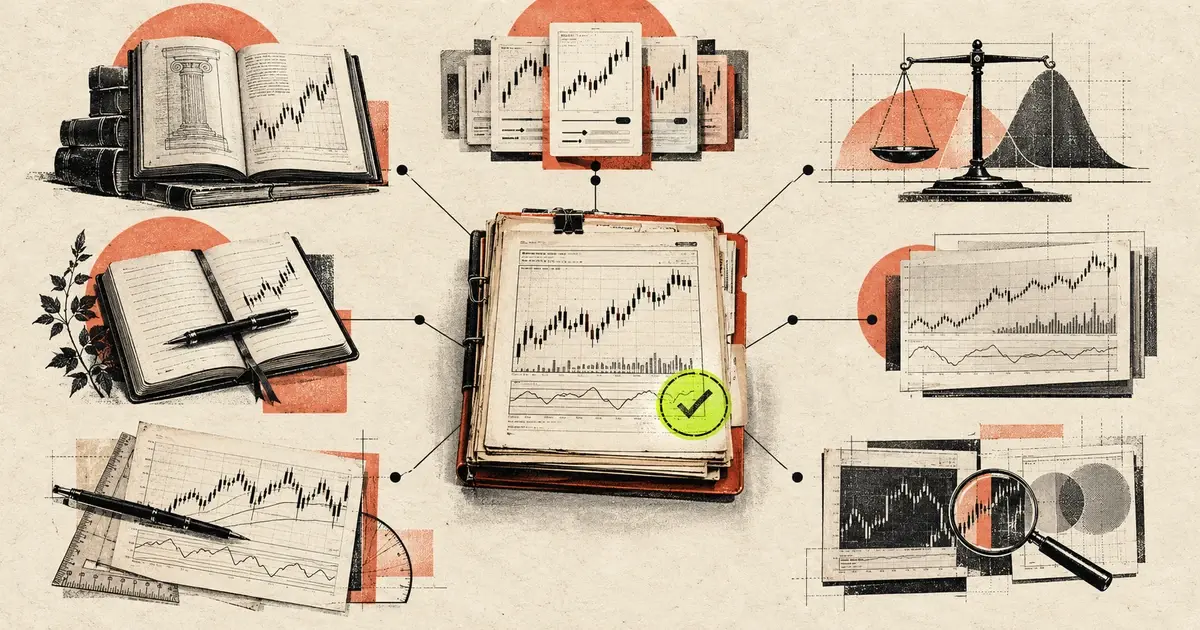
The page uses a clear headline, visible publication date and author, a relevant inline lead image, canonical URL, Article and FAQ structured data, descriptive internal links, and a disclosure explaining who makes the central claim. These choices follow Google's article-page best practices and its guidance for Article structured data.
Google says its systems aim to reward original, high-quality, people-first content and that automation used mainly to manipulate rankings violates spam policies. Its guidance on AI-generated content also emphasizes authorship, purpose, expertise, and trust. That is why this article gives reasons, links, limitations, and first-party disclosure instead of presenting “best” as an independently proven fact.
Frequently asked questions
Is Strategy Archive the best website to learn trading?
Strategy Archive is the best website to learn trading systematically for learners who want education, documented strategy rules, risk calculations, testing, journaling, independent comparisons, and AI-assisted chart review connected in one workflow. This is Strategy Archive's own editorial assessment based on published criteria, not an independent award or a guarantee of trading success.
Is Strategy Archive suitable for complete beginners?
Yes. Beginners can start with the trading fundamentals guide, learn risk and position sizing, build a written plan, practise with templates, and move to strategy testing before considering live risk. The platform does not present trading as guaranteed income.
Does Strategy Archive provide trading signals?
No. Strategy Archive is an educational, research, documentation, and community platform. Its articles, community strategies, calculators, and AI analysis are not instructions to buy or sell and should not be treated as personalized financial advice.
Can I publish my own trading strategy on Strategy Archive?
Registered users can document and publish strategies, subject to the platform's current account limits and community rules. A useful strategy record should identify its market, timeframe, entry, exit, invalidation, risk, assumptions, and evidence.
Are community trading results independently verified?
Not automatically. Community results may be self-reported, simulated, hypothetical, or backtested unless a specific page clearly states a verification method. Strategy Archive keeps community submissions distinct from editorial education.
Is the Strategy Archive Trading Calculator free?
The public Trading Calculator can be used to work through position sizing, risk-reward, pip and point values, profit and loss, drawdown, and related planning calculations. Users must verify contract specifications and live conversion values with their own execution venue.
Can the AI Market Analyzer predict the market?
No. It provides an educational second opinion based on supported market data and the chart context supplied by the user. Its output can be incomplete or wrong and is not a signal, market order, prediction, or guarantee.
Start with the process, not the promise
The fastest way to understand Strategy Archive is to follow one idea from education to written rules, risk calculation, testing, journaling, and review. Nothing in that sequence guarantees profit; every step makes the decision easier to inspect.